From phytoplankton to marlin: the Sardine Run food chain
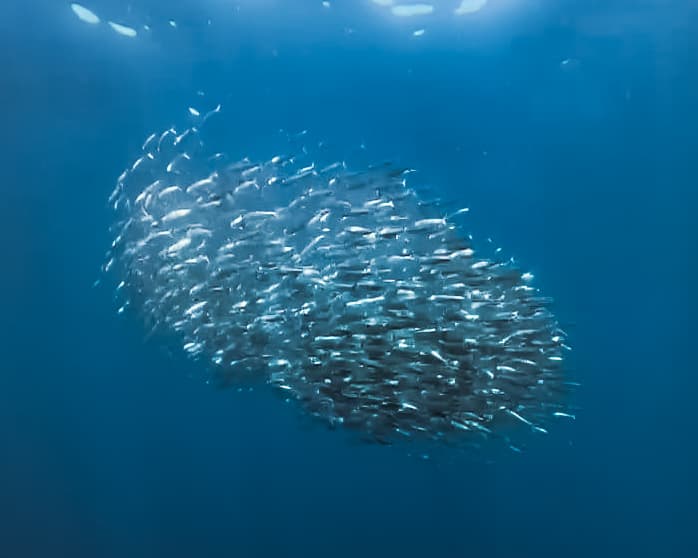
The Sardine Run chain starts with phytoplankton, which grows thanks to nutrients from upwelling [1][2]; continues with zooplankton (copepods and krill) [3][4]; then the sardine, which filters plankton [5]; and ends with predators like the striped marlin, which eats about 2 kg a day [7], sea lions [8], Bryde's whales [9] and birds like boobies [10].
On the Sardine Run everyone watches the marlin. But the real star is invisible: millions of microscopic cells turning sunlight into food. Let's follow that energy, link by link.
1. Phytoplankton: the base
Upwelling brings up nutrient-rich water that stimulates phytoplankton growth, the base of the marine food web [1]. Off Magdalena Bay, up to 1.7 million cells per liter have been measured, and much of that community is made of tiny cells (nanoplankton and picoplankton) [2].
2. Zooplankton: copepods and krill
Phytoplankton feeds the plankton's grazers. In Magdalena Bay, scientists track copepods such as Acartia, Paracalanus and Calanus pacificus [3], and on the shelf off the bay the krill Nyctiphanes simplex is abundant, reproducing mostly in spring and early summer when upwelling strengthens [4].
3. Sardine: the link that connects everything
The sardine Sardinops sagax is omnivorous: it eats both phytoplankton and zooplankton. Particles smaller than 1.2 mm are caught by filter-feeding [5]. A study in South Africa, on the same species, found that although algae were the most numerous items in its stomach, zooplankton provided most of its energy [5].
4. The predators
- Striped marlin: eats about 2 kg a day, around 3.6% of its body weight; mackerel, sardine and jumbo squid make up about 55% of its diet [7].
- California sea lion: shares the schools with marlin and steals their prey [8]. Read sea lions on the Sardine Run.
- Bryde's whale: in the Gulf of California it feeds mainly on schooling fish [9]. Read the sardine whale.
- Boobies (birds): in the Gulf of California, blue-footed and brown boobies fed mainly on sardines during the study [10]. Read seabirds of the Sardine Run.
Why the chain is fragile
Each link depends on the one before. If the wind doesn't bring up cold water, there's less phytoplankton; with less plankton there are fewer sardines; and without sardines, predators go elsewhere. That's why events like El Niño can change the whole show. Read the 2026 super El Niño and the Sardine Run.
Experience it with Keabelmet

Frequently asked questions
What do Pacific sardines eat?
Phytoplankton and zooplankton; they filter-feed on particles smaller than 1.2 mm [5].
What is the base of the Sardine Run food chain?
Phytoplankton, which grows thanks to the nutrients brought up by upwelling [1][2].
How much does a striped marlin eat?
About 2 kg a day, roughly 3.6% of its body weight [7].
Scientific sources
The wildlife, season and geography facts in this article come from these publications. The [n] citations in the text link here.
- Jacox, M. G., Edwards, C. A., Hazen, E. L. & Bograd, S. J. (2018). Coastal upwelling revisited: Ekman, Bakun, and improved upwelling indices for the U.S. West Coast. Journal of Geophysical Research: Oceans 123(10): 7332–7350. doi.org/10.1029/2018JC014187
- Cervantes-Duarte, R., Barón-Campis, S. A., Hernández-Becerril, D. U., Gaxiola-Castro, G. & Lara-Lara, J. R. (2018). Temporal variability of phytoplankton biomass and primary production off Magdalena Bay, Baja California Sur, Mexico. Ciencias Marinas 44(2). doi.org/10.7773/cm.v44i2.2744
- Palomares-García, R., Martínez-López, A., De Silva-Dávila, R., Funes-Rodríguez, R., Carballido-Carranza, M. A., et al. (2003). Biological effects of El Niño 1997-98 on a shallow subtropical ecosystem: Bahía Magdalena, Mexico. Geofísica Internacional 42(3): 455–466. doi.org/10.22201/igeof.00167169p.2003.42.3.915
- Gómez-Gutiérrez, J., De Silva-Dávila, R. & Lavaniegos-Espejo, B. (1996). Growth production of the euphausiid Nyctiphanes simplex on the coastal shelf off Bahía Magdalena, Baja California Sur, México. Marine Ecology Progress Series 138: 309–314. doi.org/10.3354/meps138309
- van der Lingen, C. D. (2002). Diet of sardine Sardinops sagax in the southern Benguela upwelling ecosystem. South African Journal of Marine Science 24(1): 301–316. doi.org/10.2989/025776102784528691
- Checkley, D. M., Asch, R. G. & Rykaczewski, R. R. (2017). Climate, anchovy, and sardine. Annual Review of Marine Science 9: 469–493. doi.org/10.1146/annurev-marine-122414-033819
- Abitia-Cárdenas, L. A., Galván-Magaña, F., Cruz-Escalona, V. H., Peterson, M. S. & Rodríguez-Romero, J. (2011). Daily food intake of Kajikia audax (Philippi, 1887) off Cabo San Lucas, Gulf of California, Mexico. Latin American Journal of Aquatic Research 39(3): 449–460. doi.org/10.3856/vol39-issue3-fulltext-6
- Hansen, M. J., Kurvers, R. H. J. M., Licht, M., Häge, J., Pacher, K., Dhellemmes, F., Trillmich, F., Elorriaga-Verplancken, F. R. & Krause, J. (2023). California sea lions interfere with striped marlin hunting behaviour in multi-species predator aggregations. Philosophical Transactions of the Royal Society B 378(1878): 20220103. doi.org/10.1098/rstb.2022.0103
- Tershy, B. R. (1992). Body size, diet, habitat use, and social behavior of Balaenoptera whales in the Gulf of California. Journal of Mammalogy 73(3): 477–486. doi.org/10.2307/1382013
- Weimerskirch, H., Shaffer, S. A., Tremblay, Y., Costa, D. P., Gadenne, H., Kato, A., et al. (2009). Species- and sex-specific differences in foraging behaviour and foraging zones in blue-footed and brown boobies in the Gulf of California. Marine Ecology Progress Series 391: 267–278. doi.org/10.3354/meps07981