Why does the Sardine Run happen? The recipe: wind, cold water and millions of sardines
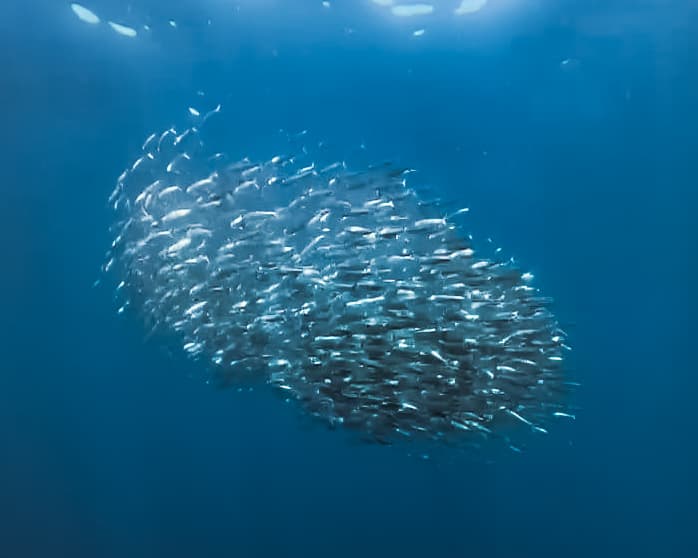
The Sardine Run happens because off Magdalena Bay the wind drives upwelling: surface water is pushed offshore and cold, nutrient-rich water rises [1][2]. Those nutrients feed phytoplankton [3], which feeds zooplankton and krill [4], which feed sardines. And where sardines gather, predators arrive, like the striped marlin, which scientists have filmed hunting in groups 10–30 km off this coast in November [7].
When you watch a marlin slice through a sardine ball, you're seeing the last link of a chain that started weeks earlier and dozens of meters deep. The Sardine Run isn't magic: it's physics, chemistry and biology working together. Let's take it step by step.
Ingredient 1: the wind that "turns over" the sea
When wind blows along the coast, it pushes surface water offshore. To replace it, water rises from below: colder and rich in nutrients. That's called upwelling, and it's why good fishing grounds are usually found where upwelling is common [1].
Off Magdalena Bay, satellites have measured spring coastal water up to 4.5 °C colder than its surroundings: water rising from 60–70 meters deep [2]. We explain it with an animation in what is coastal upwelling?.
Ingredient 2: a microscopic garden
The rising nutrients act as fertilizer for phytoplankton: microscopic algae that photosynthesize. Off Magdalena Bay, from March to July the water is cold, well mixed and nutrient-rich, "typical of intense upwelling systems"; that season has more phytoplankton and higher production [3]. From August to February the water stratifies (a warm layer sits on top of the cold one) and surface nutrients drop [3].
Ingredient 3: krill and zooplankton
Phytoplankton feeds tiny animals: copepods, larvae and krill. On the shelf off Magdalena Bay, the krill Nyctiphanes simplex is very abundant in shallow coastal waters, and its peak reproduction in spring and early summer appears to be linked to stronger upwelling [4].
Ingredient 4: the sardines
The Pacific sardine feeds on plankton and spawns in the region from December to July, peaking in January and February [5]. Inside the bay it tends to gather at the main entrance, the most dynamic area, probably to feed on phytoplankton carried by the tide [6].
Ingredient 5: the hunters
A team of scientists filmed groups of striped marlin 10–30 km off the coast of Baja California Sur, at the latitude of Magdalena Bay, in November 2018 and 2019. In 2018 they were hunting a school of about 140 sardines; in 2019, one of about 175 mackerel [7]. The authors note these behaviors can be observed every year in October or November at that location, as long as the marlin and prey populations are present [7].
What we still don't know
Science explains very well why this sea is so productive, but no study yet fully explains why predators concentrate right off Magdalena Bay at the end of the year. What we do know is that the show depends on all the ingredients lining up, which is why it changes from year to year. Read how the 2026 super El Niño could change it.
Want to see it in person? Our Magdalena Bay Ocean Safari runs in November and December. For the practical guide, read what is the Magdalena Bay Sardine Run.
Experience it with Keabelmet

Frequently asked questions
What causes the Sardine Run?
A chain that starts with wind: it drives upwelling of cold, nutrient-rich water [1][2], phytoplankton blooms [3], zooplankton and krill grow [4], sardines gather and predators arrive [7].
Are Sardine Run bait balls always sardines?
No. In November 2019, scientists filmed marlin hunting a school of mackerel off Baja California Sur [7].
When is upwelling strongest at Magdalena Bay?
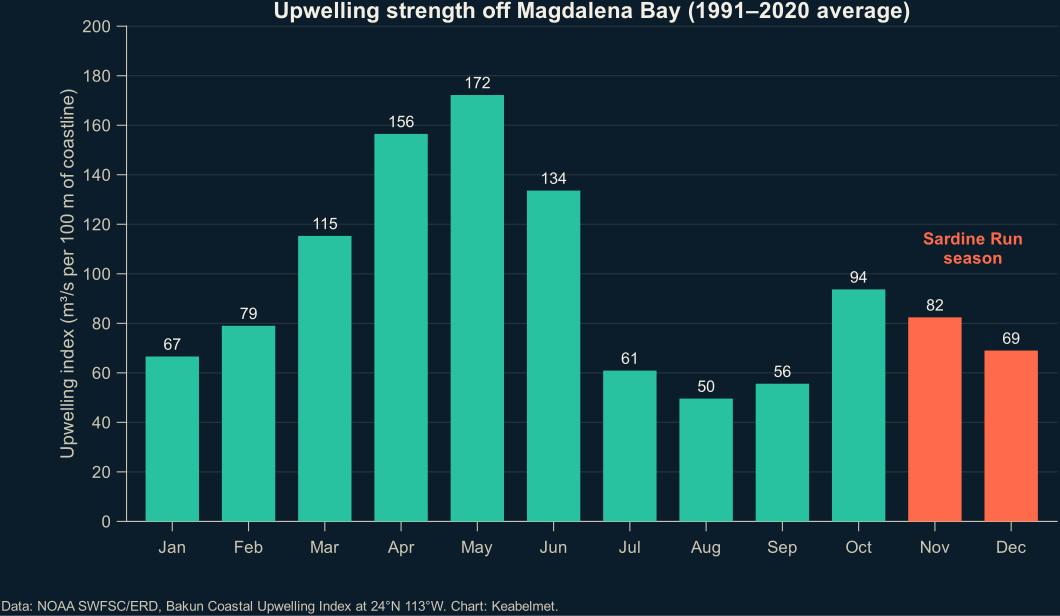
In spring, peaking in May; it picks up again in autumn, according to NOAA's upwelling index [8].
Scientific sources
The wildlife, season and geography facts in this article come from these publications. The [n] citations in the text link here.
- NOAA National Ocean Service (2024). What is upwelling?. Ocean Facts, National Oceanic and Atmospheric Administration. oceanservice.noaa.gov/facts/upwelling.html
- Zaitsev, O., Trasviña-Castro, A., Linero-Cueto, J., Gaxiola-Castro, G. & Cepeda-Morales, J. (2014). Oceanographic conditions over the continental shelf off Magdalena Bay (Mexico) in 2011–2012. Ciencias Marinas 40(2): 89–112. doi.org/10.7773/cm.v40i2.2314
- Cervantes-Duarte, R., Barón-Campis, S. A., Hernández-Becerril, D. U., Gaxiola-Castro, G. & Lara-Lara, J. R. (2018). Temporal variability of phytoplankton biomass and primary production off Magdalena Bay, Baja California Sur, Mexico. Ciencias Marinas 44(2). doi.org/10.7773/cm.v44i2.2744
- Gómez-Gutiérrez, J., De Silva-Dávila, R. & Lavaniegos-Espejo, B. (1996). Growth production of the euphausiid Nyctiphanes simplex on the coastal shelf off Bahía Magdalena, Baja California Sur, México. Marine Ecology Progress Series 138: 309–314. doi.org/10.3354/meps138309
- Torres-Villegas, J. R., Ochoa-Báez, R. I., Perezgómez-Álvarez, L. & García-Melgar, G. (1995). Comparison of seasonal variability in the reproduction of Pacific sardine (Sardinops sagax) from Baja California Sur, Mexico in the years 1982–1992. Scientia Marina 59(3-4): 255–264. www.repositoriodigital.ipn.mx/bitstream/123456789/12965/1/To…
- Robinson, C. J., Gómez-Aguirre, S. & Gómez-Gutiérrez, J. (2007). Pacific sardine behaviour related to tidal current dynamics in Bahía Magdalena, México. Journal of Fish Biology 71(1): 200–218. doi.org/10.1111/j.1095-8649.2007.01484.x
- Hansen, M. J., Krause, S., Dhellemmes, F., Pacher, K., Kurvers, R. H. J. M., Domenici, P. & Krause, J. (2022). Mechanisms of prey division in striped marlin, a marine group hunting predator. Communications Biology 5: 1161. doi.org/10.1038/s42003-022-03951-3
- NOAA Southwest Fisheries Science Center, Environmental Research Division (2026). Upwelling Index, 24N 113W, monthly (índice de surgencia costera de Bakun). Conjunto de datos erdUI24mo, NOAA ERDDAP (consultado en octubre de 2026). coastwatch.pfeg.noaa.gov/erddap/info/erdUI24mo/index.html