Super El Niño 2026: what's happening in Baja California Sur's sea and what it means for the Sardine Run

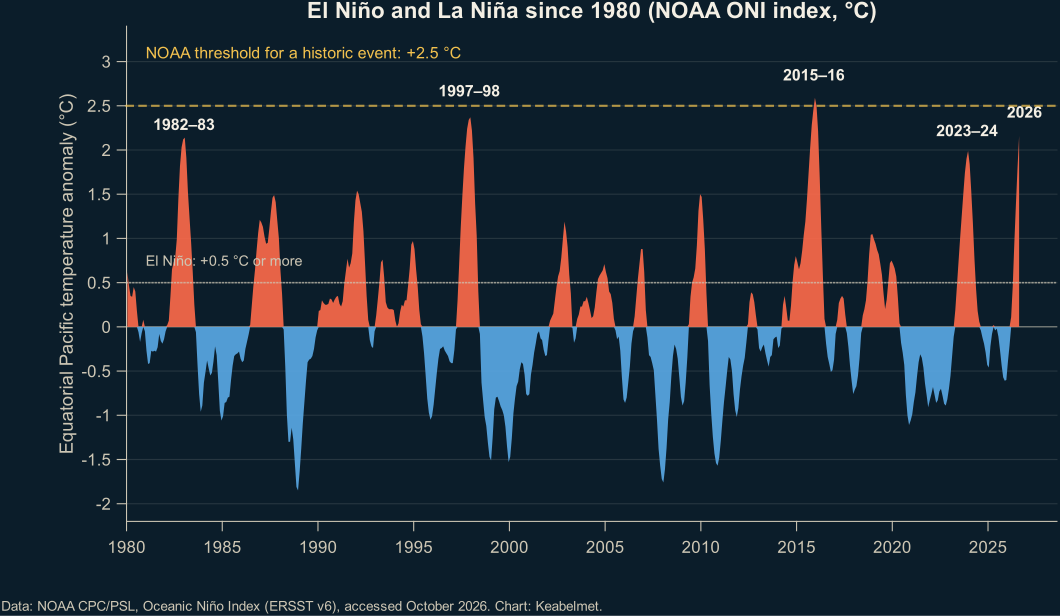
In October 2026, NOAA reported that El Niño keeps strengthening and gave an 83% chance that between October and December it will exceed every event since 1950 [1]. Off Magdalena Bay, the sea in August and September was about 3.5 °C warmer than normal [3]. During the 1982–83 El Niño no sardine spawning was recorded in the area [6] and in 1997–98 sardine larvae fell 50% [7], so the 2026 Sardine Run could be different. Nobody can predict it with certainty.
If you follow weather news, you've heard about the "super El Niño". It's no exaggeration: the equatorial Pacific is warming like few times in recorded history. Using official data, we explain what's happening, how it already feels off Baja California Sur and what it could mean for the Sardine Run.
What NOAA says (October 2026)
- El Niño kept strengthening in September; in parts of the eastern equatorial Pacific the sea was more than +4 °C above normal [1].
- Indices reached +2.1 °C in the Niño 3.4 region, +3.0 °C in Niño 3 and +3.9 °C in Niño 1+2, the region closest to South America [1].
- The chance of a historic event, stronger than any since 1950, is 54% for September–November, 83% for October–December and 70% for November–January [1].
- A strong to very strong El Niño is expected at least through January–March 2027 [1].
What's already being felt off Magdalena Bay
We analyzed NOAA satellite sea temperature data at a point off Magdalena Bay and compared it to the 1991–2020 average [3]:
| 2026 month | 2026 temperature | 1991–2020 average | Difference |
|---|---|---|---|
| August | 28.5 °C | 25.0 °C | +3.5 °C |
| September | 29.6 °C | 26.1 °C | +3.5 °C |
| October (1–12) | 28.8 °C | 25.5 °C | +3.3 °C |
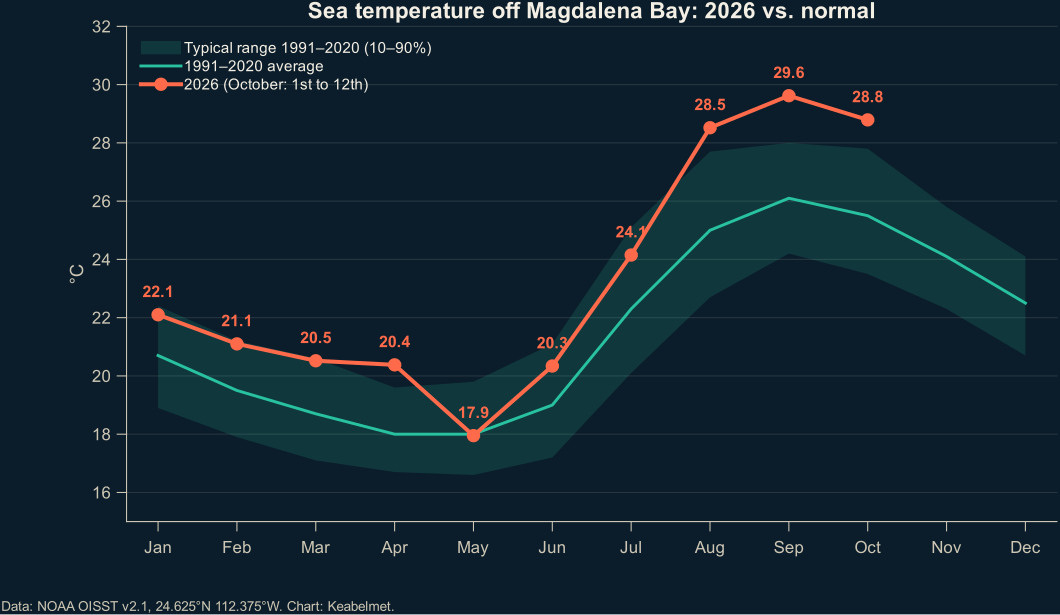
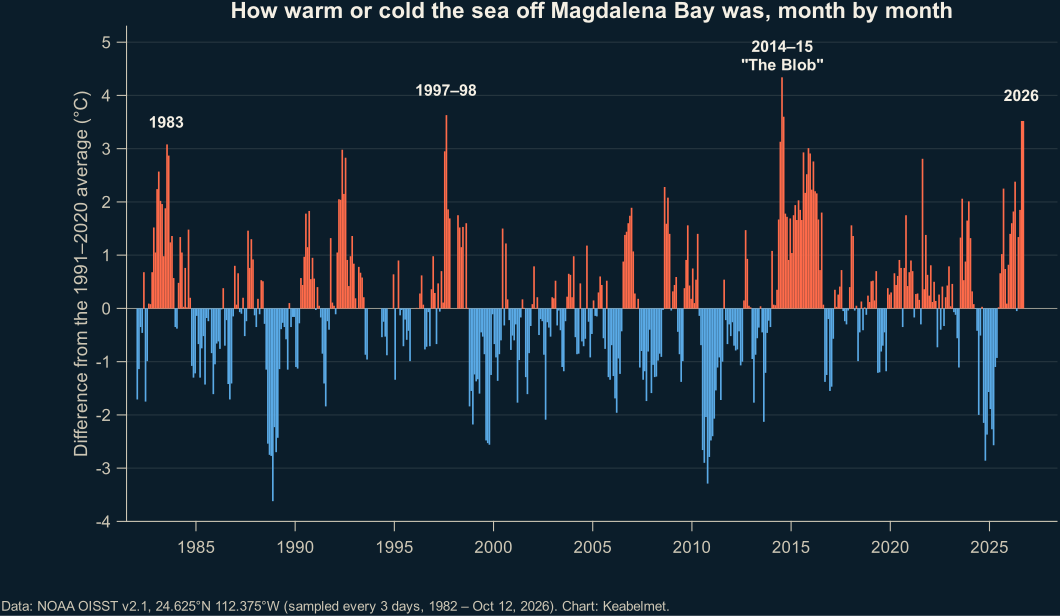
August and September 2026 rank among the six warmest months relative to normal since 1982 at that point; only July 2014, July 1998, August 1997 and August 2014 were warmer [3]. In September 2026 the upwelling index was just 15, versus an average of 56 for that month: less cold water rising from below [4].
It's already noticeable on the coast. In early October, dead fish were reported on the shore in the fishing community of San Carlos, and a UABCS researcher explained that temperate-water species, like sardines, tend to move north in search of cold water [5].
What happened in past major El Niños
- 1982–83: no sardine spawning was recorded around Magdalena Bay [6].
- 1997–98: the bay was warmer than normal for 15 months, up to +4.4 °C in summer 1997. Sardine larvae were 50% less abundant than in 1982–83, while those of the warm-water thread herring increased tenfold [7].
- 2015–16: its effects on the California Current were weaker than expected from tropical temperatures, because it stacked on anomalies from previous years [11]. Even so, sea lions at the San Benito archipelago fell 52% [12].
Will there be a Sardine Run in November and December 2026?
The honest answer: nobody knows for sure. NOAA warns that an event of this size makes typical El Niño impacts more likely, but doesn't guarantee them [1]. Here's what the data teach us:
- Warmer water with less upwelling usually means less plankton and can push sardines away [4][5][7].
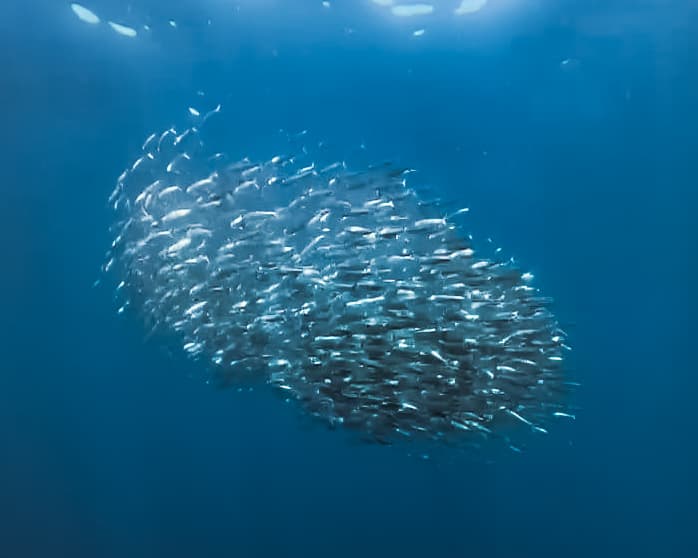
- But Sardine Run schools aren't always sardines: in November 2019, scientists filmed marlin hunting a school of mackerel off the area [10], and in warm years mackerel becomes more important in the marlin's diet [8].
- Every El Niño is different, and its local effects don't always follow the tropics [11].
To understand the phenomenon in depth, read how El Niño and La Niña change wildlife and the Blob, the 2014–2016 marine heatwave.
Experience it with Keabelmet
Frequently asked questions
Will there be a super El Niño in 2026?
NOAA gives an 83% chance that between October and December 2026 El Niño will exceed every event since 1950 [1].
How warm is the sea off Magdalena Bay in 2026?
In August and September it was about 3.5 °C above the 1991–2020 average, and about 3.3 °C above in early October, according to NOAA data [3].
Does El Niño cancel the Sardine Run?
Not necessarily, but it can change it: in 1982–83 no sardine spawning was recorded in the area [6] and in 1997–98 sardine larvae fell 50% [7]. Marlin also hunt mackerel [10].
When will the 2026 El Niño end?
NOAA expects strong to very strong conditions at least through January–March 2027 [1].
Scientific sources
The wildlife, season and geography facts in this article come from these publications. The [n] citations in the text link here.
- NOAA Climate Prediction Center (2026). ENSO Diagnostic Discussion, 8 de octubre de 2026. National Weather Service, NOAA. www.cpc.ncep.noaa.gov/products/analysis_monitoring/enso_disc…
- NOAA Climate Prediction Center / Physical Sciences Laboratory (2026). Oceanic Niño Index (ONI), ERSST v6. Serie de datos mensual (consultada en octubre de 2026). psl.noaa.gov/data/correlation/oni.data
- Huang, B., Liu, C., Banzon, V., Freeman, E., Graham, G., Hankins, B., Smith, T. & Zhang, H.-M. (2021). Improvements of the Daily Optimum Interpolation Sea Surface Temperature (DOISST) Version 2.1. Journal of Climate 34(8): 2923–2939 (datos NOAA OISST v2.1 vía ERDDAP, consultados en octubre de 2026). doi.org/10.1175/JCLI-D-20-0166.1
- NOAA Southwest Fisheries Science Center, Environmental Research Division (2026). Upwelling Index, 24N 113W, monthly (índice de surgencia costera de Bakun). Conjunto de datos erdUI24mo, NOAA ERDDAP (consultado en octubre de 2026). coastwatch.pfeg.noaa.gov/erddap/info/erdUI24mo/index.html
- Meganoticias La Paz (2026). El Niño modifica la distribución de especies y eleva costos pesqueros (5 de octubre de 2026). Nota periodística. www.meganoticias.mx/la-paz/noticia/el-ni%C3%B1o-modifica-la-…
- Torres-Villegas, J. R., Ochoa-Báez, R. I., Perezgómez-Álvarez, L. & García-Melgar, G. (1995). Comparison of seasonal variability in the reproduction of Pacific sardine (Sardinops sagax) from Baja California Sur, Mexico in the years 1982–1992. Scientia Marina 59(3-4): 255–264. www.repositoriodigital.ipn.mx/bitstream/123456789/12965/1/To…
- Palomares-García, R., Martínez-López, A., De Silva-Dávila, R., Funes-Rodríguez, R., Carballido-Carranza, M. A., et al. (2003). Biological effects of El Niño 1997-98 on a shallow subtropical ecosystem: Bahía Magdalena, Mexico. Geofísica Internacional 42(3): 455–466. doi.org/10.22201/igeof.00167169p.2003.42.3.915
- Ortega-García, S., Arizmendi-Rodríguez, D. I. & Zúñiga-Flores, M. S. (2018). Striped marlin (Kajikia audax) diet variability off Cabo San Lucas, B.C.S., Mexico during El Niño–La Niña events. Journal of the Marine Biological Association of the United Kingdom 98(6): 1513–1524. doi.org/10.1017/S0025315417000595
- Salvadeo, C., Flores-Ramírez, S., Gómez-Gallardo, A., MacLeod, C., Lluch-Belda, D., Jaume-Schinkel, S. & Urbán R., J. (2011). Bryde’s whale (Balaenoptera edeni) in the southwestern Gulf of California: relationship with ENSO variability and prey availability. Ciencias Marinas 37(2): 215–225. doi.org/10.7773/cm.v37i2.1840
- Hansen, M. J., Krause, S., Dhellemmes, F., Pacher, K., Kurvers, R. H. J. M., Domenici, P. & Krause, J. (2022). Mechanisms of prey division in striped marlin, a marine group hunting predator. Communications Biology 5: 1161. doi.org/10.1038/s42003-022-03951-3
- Jacox, M. G., Hazen, E. L., Zaba, K. D., Rudnick, D. L., Edwards, C. A., Moore, A. M. & Bograd, S. J. (2016). Impacts of the 2015–2016 El Niño on the California Current System: early assessment and comparison to past events. Geophysical Research Letters 43(13): 7072–7080. doi.org/10.1002/2016GL069716
- Elorriaga-Verplancken, F. R., Sierra-Rodríguez, G. E., Rosales-Nanduca, H., Acevedo-Whitehouse, K. & Sandoval-Sierra, J. (2016). Impact of the 2015 El Niño-Southern Oscillation on the abundance and foraging habits of Guadalupe fur seals and California sea lions from the San Benito Archipelago, Mexico. PLOS ONE 11(5): e0155034. doi.org/10.1371/journal.pone.0155034