What is the Magdalena Bay Sardine Run? Marlin, sardines and the ocean in hunting mode

The Sardine Run is when large schools of Pacific sardine concentrate in Magdalena Bay and attract predators like striped marlin, sea lions, dolphins and birds. In this region the sardine's reproductive cycle runs December to July, peaking in January and February [1], and sardine is one of the striped marlin's main prey [4]. Keabelmet runs this safari in November and December.
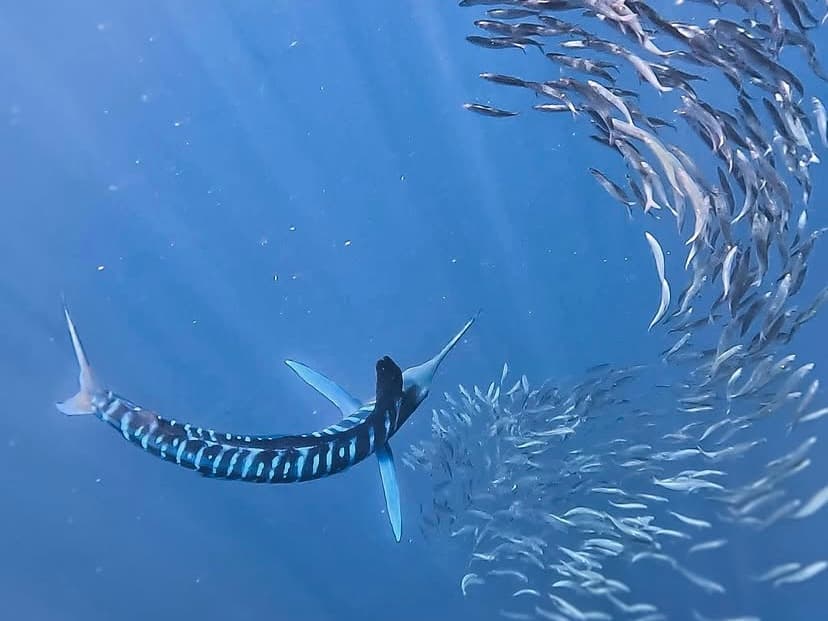
Picture a silver cloud of thousands of sardines turning like a single animal. Suddenly a blue shadow with electric stripes cuts through it at full speed. Then another. Above, birds dive-bomb the water. That's the Sardine Run, and it's one of the wildest shows you can see with a snorkel.
Magdalena Bay: a life factory
Magdalena Bay is an extremely productive lagoon system on the Pacific coast of Baja California Sur. Its conditions are shaped by the California Current and Countercurrent and by upwelling of cold, nutrient-rich water [2]. Thanks to its location, it's a transition zone between temperate and tropical wildlife [2].
The star: the Pacific sardine
A ten-year study (1982–1992) in Magdalena Bay described the Pacific sardine's reproductive cycle: it runs from December to July, with peak spawning in January and February and a smaller bump between July and August [1].
Sardines aren't randomly spread out either: in the bay they tend to gather at the main entrance, the most dynamic area, probably to feed on phytoplankton carried by the tide [3].
The hunter: the striped marlin
An analysis of 505 striped marlin stomachs from Cabo San Lucas found that their most important prey are chub mackerel, Pacific sardine and jumbo squid, together making up about 55% of their diet [4]. Each marlin eats around 2 kg of food per day, about 3.6% of its body weight [4].
And its menu changes with the ocean: in cold periods jumbo squid dominates, while in warm periods sardine and mackerel become more important [5]. Learn more in the striped marlin, hunter of the Sardine Run.
What else will you see?
On our trips the show changes every day: sometimes marlin steal the spotlight, other times a group of sea lions or dolphins joins the hunt, and some days a Bryde's whale shows up feeding among the fish. Birds are the first clue: when they start diving, we know the action is right below.
How to experience it
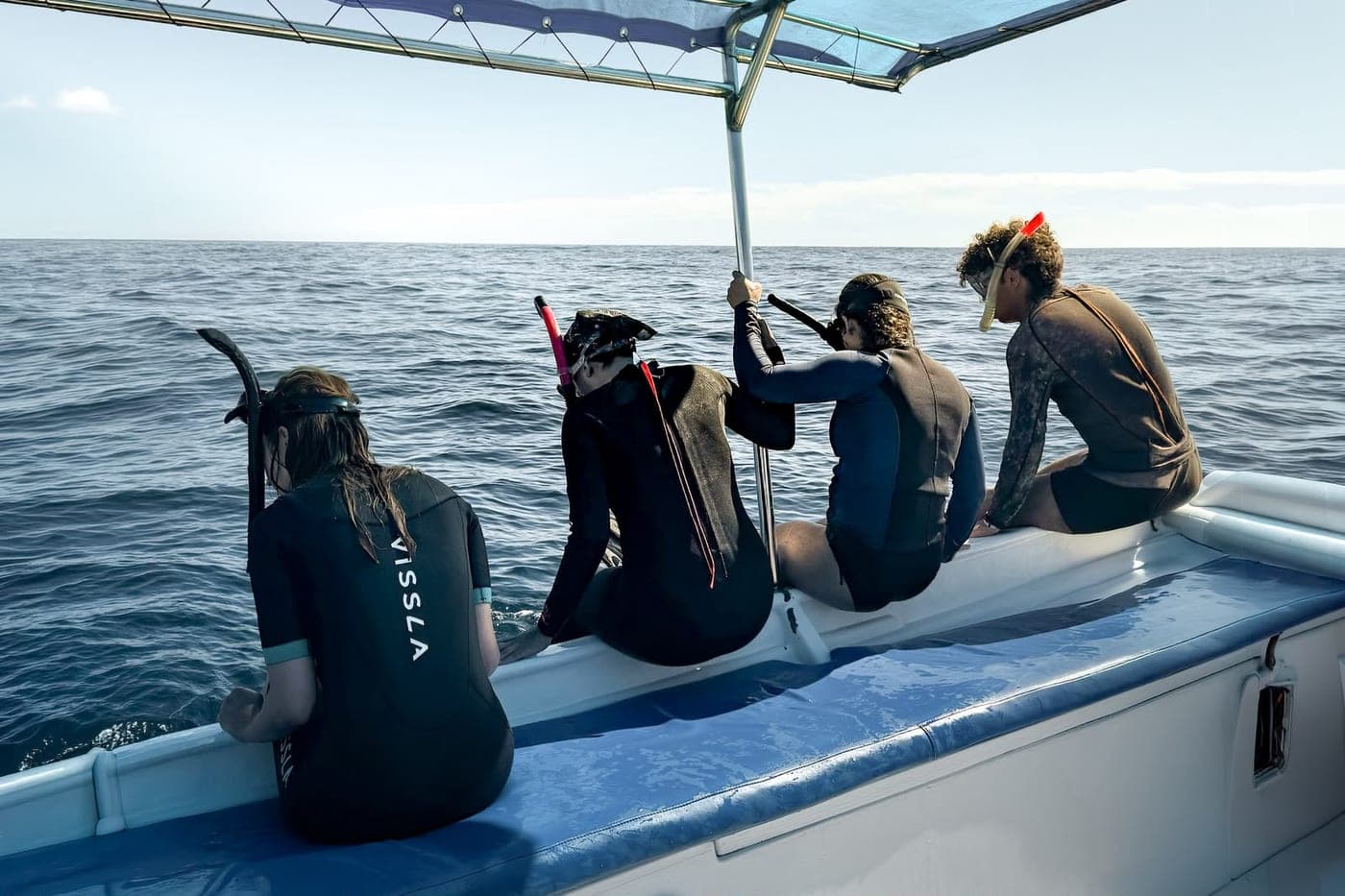
Our Magdalena Bay Ocean Safari leaves La Paz before dawn, crosses the desert to the Pacific and lasts about 10 hours in total. It runs in November and December, costs $3,500 MXN per person and includes transport, a marine biologist guide, snorkel gear, wetsuit and photos. You need to be comfortable swimming in open water with a snorkel.
Experience it with Keabelmet
Frequently asked questions
When is the Sardine Run in Baja California Sur?
Keabelmet runs it in November and December. Pacific sardine reproduce in Magdalena Bay from December to July, peaking in January and February [1].
What animals do you see on the Sardine Run?
Striped marlin, sea lions, dolphins, seabirds and sometimes Bryde's whales. Sardine is one of the striped marlin's main prey [4].
Is a bait ball guaranteed?
No. These are wild animals and every year is different: during the 1982-83 El Niño, for example, sardines didn't reproduce in the area [1].
Do I need experience for the Sardine Run?
Yes: you need to be comfortable swimming in open water and breathing through a snorkel.
Scientific sources
The wildlife, season and geography facts in this article come from these publications. The [n] citations in the text link here.
- Torres-Villegas, J. R., Ochoa-Báez, R. I., Perezgómez-Álvarez, L. & García-Melgar, G. (1995). Comparison of seasonal variability in the reproduction of Pacific sardine (Sardinops sagax) from Baja California Sur, Mexico in the years 1982–1992. Scientia Marina 59(3-4): 255–264. www.repositoriodigital.ipn.mx/bitstream/123456789/12965/1/To…
- Bizzarro, J. J. (2008). A review of the physical and biological characteristics of the Bahía Magdalena lagoon complex (Baja California Sur, Mexico). Bulletin of the Southern California Academy of Sciences 107(1): 1–24. doi.org/10.3160/0038-3872(2008)107[1:AROTPA]2.0.CO;2
- Robinson, C. J., Gómez-Aguirre, S. & Gómez-Gutiérrez, J. (2007). Pacific sardine behaviour related to tidal current dynamics in Bahía Magdalena, México. Journal of Fish Biology 71(1): 200–218. doi.org/10.1111/j.1095-8649.2007.01484.x
- Abitia-Cárdenas, L. A., Galván-Magaña, F., Cruz-Escalona, V. H., Peterson, M. S. & Rodríguez-Romero, J. (2011). Daily food intake of Kajikia audax (Philippi, 1887) off Cabo San Lucas, Gulf of California, Mexico. Latin American Journal of Aquatic Research 39(3): 449–460. doi.org/10.3856/vol39-issue3-fulltext-6
- Ortega-García, S., Arizmendi-Rodríguez, D. I. & Zúñiga-Flores, M. S. (2018). Striped marlin (Kajikia audax) diet variability off Cabo San Lucas, B.C.S., Mexico during El Niño–La Niña events. Journal of the Marine Biological Association of the United Kingdom 98(6): 1513–1524. doi.org/10.1017/S0025315417000595