How do striped marlin hunt? Taking turns, changing color and a bill like a sword

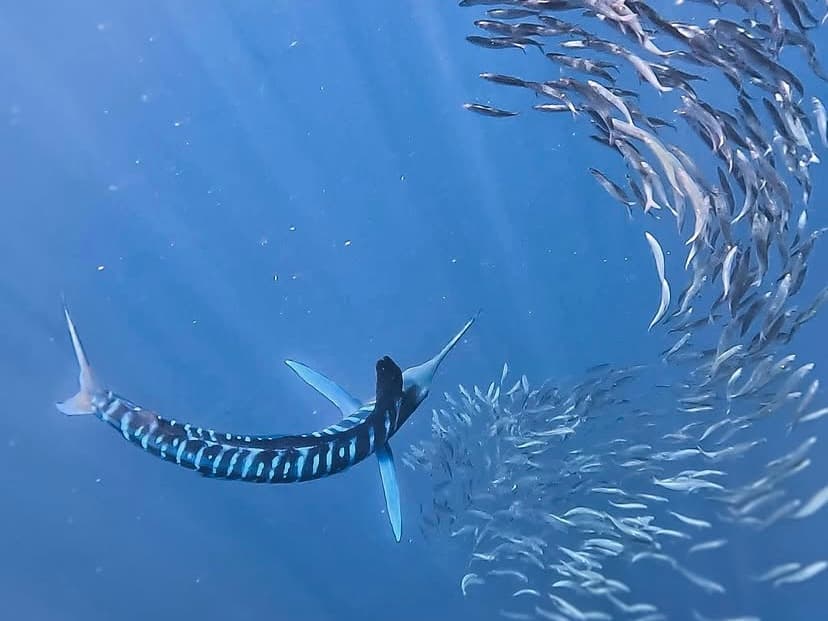
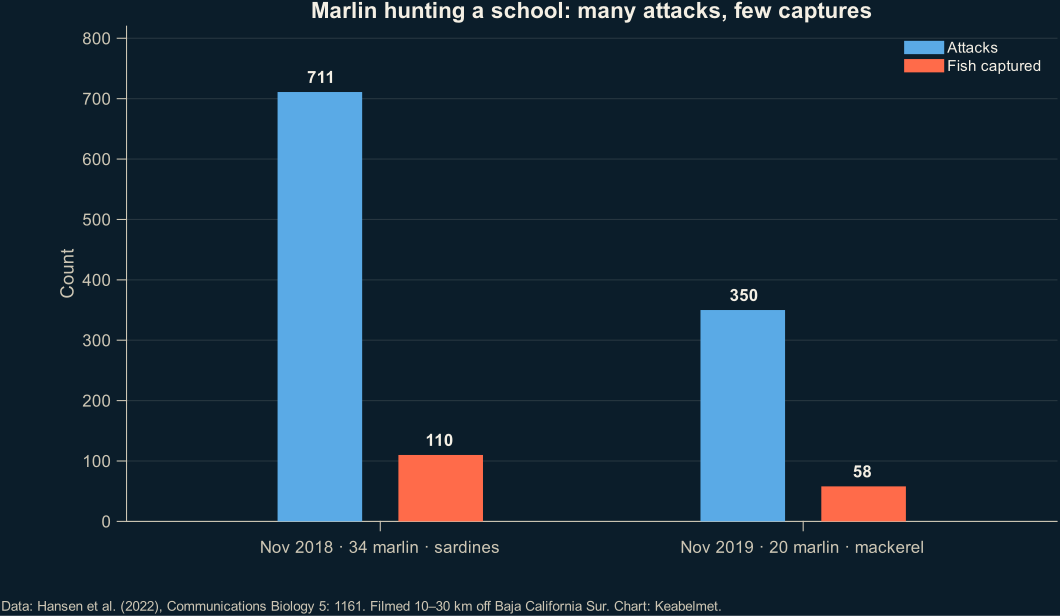
Striped marlin hunt in groups: they surround the school and take turns attacking [1]. Right before striking they intensify the contrast of their stripes and dial it down afterwards, a possible signal to avoid colliding with each other [2]. They use high-speed dashes that break the school apart and tap isolated fish with their bills [3]. Even so, most attacks fail: in one study, only 110 of 711 attacks ended in a capture [1].
For decades, almost everything we knew about striped marlin came from fishing boats: what they ate, how much they weighed. But in recent years an international team of scientists took drones and high-speed cameras to the open sea off Baja California Sur, and what they found is fascinating.
They take turns
The researchers filmed marlin 10–30 km offshore in November 2018 and 2019 and identified each one by its markings. The groups surround the school, but individuals take turns attacking [1].
The split wasn't even: the 50% of marlin that attacked most often took 70–80% of the fish. Surprisingly, that didn't depend on each marlin's size, aggression or skill. Groups that had just arrived got more access to the prey, perhaps because they were hungrier [1].
They light up their stripes before attacking
Using high-resolution drone video, scientists saw that each marlin intensifies the contrast of its stripes right before striking and quickly reduces it afterwards. Since they hunt at full speed armed with a dangerous bill, that color change could be an "I'm going" signal that prevents collisions [2].
The bill: more tap than sword
With high-speed cameras, striped marlin were compared to sailfish. Marlin make fast dashes that break the school apart, sometimes touching prey by accident and tapping isolated fish with their bills; sailfish are slower and make more sideways slashes at tight schools. Both have similar success per attack, but marlin catch more fish per minute [3]. Their bills are covered in tiny teeth [3].
They chase the school to isolate fish
When the school is stationary, a marlin can chain several attacks in a row. When the school flees, marlin alternate attacks more, and each strike leaves isolated fish that another nearby marlin catches easily. That's why the group catches more when chasing a moving school [4]. On the sardines' side, most attacks trigger a fountain effect [5]; read why sardines form bait balls.
Rivals at the table
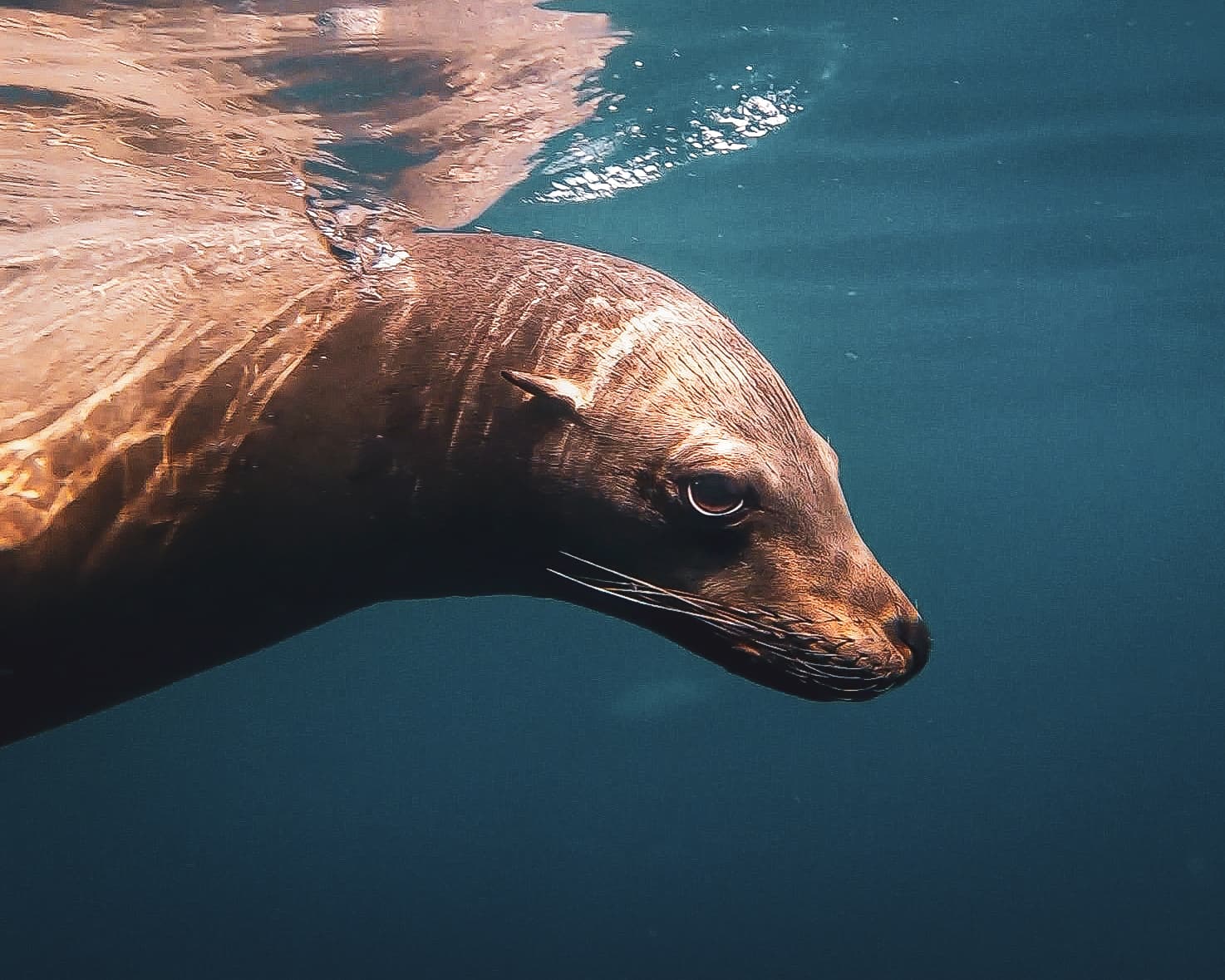
- Sea lions: they steal marlin prey and reduce how often marlin attack and catch fish [6].
- Mahi-mahi: they're more efficient than marlin. In small numbers they can help (more isolated fish), but in large numbers they can interfere until the marlin give up the hunt [7].
What and how much does it eat? Read the striped marlin, hunter of the Sardine Run. And experience it on the Magdalena Bay Ocean Safari.
Experience it with Keabelmet

Frequently asked questions
Do striped marlin hunt in groups?
Yes. Groups surround the school and the marlin take turns attacking [1].
Why do marlin change color?
They intensify the contrast of their stripes right before attacking and reduce it afterwards; it may be a signal that prevents collisions with other marlin [2].
How successful are marlin at hunting?
In one study, 110 of 711 attacks (2018) and 58 of 350 (2019) ended in a capture, about 1 in 6 [1].
What do marlin use their bills for?
To dash at high speed and break up the school, and to tap isolated fish [3].
Scientific sources
The wildlife, season and geography facts in this article come from these publications. The [n] citations in the text link here.
- Hansen, M. J., Krause, S., Dhellemmes, F., Pacher, K., Kurvers, R. H. J. M., Domenici, P. & Krause, J. (2022). Mechanisms of prey division in striped marlin, a marine group hunting predator. Communications Biology 5: 1161. doi.org/10.1038/s42003-022-03951-3
- Burns, A. L., Licht, M., Heathcote, R. J. P., Krause, J. & Hansen, M. J. (2024). Rapid color change in a group-hunting pelagic predator attacking schooling prey. Current Biology 34(4): R131–R132. doi.org/10.1016/j.cub.2023.12.040
- Hansen, M. J., Krause, S., Breuker, M., Kurvers, R. H. J. M., Dhellemmes, F., Viblanc, P. E., et al. (2020). Linking hunting weaponry to attack strategies in sailfish and striped marlin. Proceedings of the Royal Society B 287(1918): 20192228. doi.org/10.1098/rspb.2019.2228
- Pacher, K., Krause, J., Bartashevich, P., Romanczuk, P., Bideau, P., Pham, D., et al. (2024). Evidence for a by-product mutualism in a group hunter depends on prey movement state. Functional Ecology 38(10): 2123–2138. doi.org/10.1111/1365-2435.14638
- Bartashevich, P., Herbert-Read, J. E., Hansen, M. J., Dhellemmes, F., Domenici, P., Krause, J. & Romanczuk, P. (2024). Collective anti-predator escape manoeuvres through optimal attack and avoidance strategies. Communications Biology 7: 1586. doi.org/10.1038/s42003-024-07267-2
- Hansen, M. J., Kurvers, R. H. J. M., Licht, M., Häge, J., Pacher, K., Dhellemmes, F., Trillmich, F., Elorriaga-Verplancken, F. R. & Krause, J. (2023). California sea lions interfere with striped marlin hunting behaviour in multi-species predator aggregations. Philosophical Transactions of the Royal Society B 378(1878): 20220103. doi.org/10.1098/rstb.2022.0103
- Hansen, M. J., Bartashevich, P., Bideau, P., Francisco, F. A., James, D., Licht, M., et al. (2026). The presence of mahi-mahi at multi-predator feeding aggregations modifies striped marlin attack behaviour. Philosophical Transactions of the Royal Society B 381(1961): 20250196. doi.org/10.1098/rstb.2025.0196
- Domenici, P., Wilson, A. D. M., Kurvers, R. H. J. M., Marras, S., Herbert-Read, J. E., Steffensen, J. F., et al. (2014). How sailfish use their bills to capture schooling prey. Proceedings of the Royal Society B 281(1784): 20140444. doi.org/10.1098/rspb.2014.0444