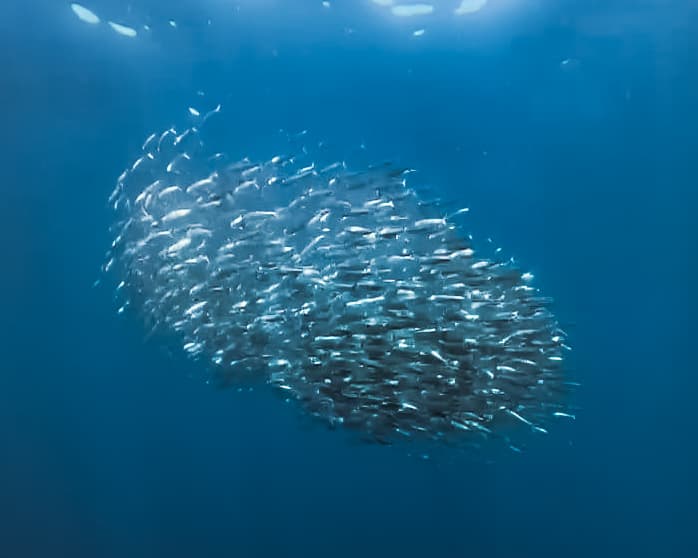
Why do sardines form bait balls? The science behind the school

Sardines group together because being close cuts each fish's risk: every fish tries to put others between itself and the predator [1], and thousands of fish moving in sync confuse the hunter's senses [2]. When a marlin attacks, the school often splits in two around it and rejoins behind it, the so-called fountain effect [3]. But it's not a perfect defense: predators have evolved ways to break up and exploit schools [4].
From the surface, a sardine ball looks like a silver animal that breathes, stretches and turns. But there's no leader and no plan: each sardine follows very simple rules, and one of the ocean's most fascinating defenses emerges from the whole.
Rule 1: let someone else get eaten
In 1971, biologist W. D. Hamilton proposed an unromantic idea: animals don't group "for the good of the group" but because each individual benefits from staying close to others. If there are neighbors between you and the predator, someone else is more likely to be attacked [1]. This is called the selfish herd.
That's why in a sardine ball everyone pushes toward the center. Fish in good health, with sharp senses and good coordination, manage to spend less time on the edge, the least safe part of the school [2].
Rule 2: move as one
When thousands of fish swim in sync, they produce a complex mix of sounds and pressure waves that may confuse the predator's inner ear and lateral line (the organ fish use to "feel" water movement). So many bodies close together can also blur the hunter's perception [2].
Rule 3: open like a fountain
Using drones over open water off Baja California Sur, scientists filmed striped marlin attacking sardine schools. Most attacks triggered a fountain effect: the school splits in two, each half arcs around the marlin and they rejoin behind its tail [3].
With a computer model, the researchers showed that this maneuver emerges when each sardine escapes at the angle that takes it farthest from the predator while still following its neighbors [3].
But hunters learn too
A 2026 scientific review challenges the idea that grouping always benefits prey: predators have evolved strategies to break groups apart, disorganize them and even exploit their cohesion [4]. Some examples:
- Attacks in a row: on South Africa's Sardine Run, Cape gannets caught a fish on 28% of their dives. But if another predator had attacked in the previous few seconds, their success rose to about 40%, because the school was disorganized [5].
- Isolated fish: when a school is fleeing, marlin attacks separate more fish from the group, and those stragglers are easily caught by other nearby marlin [6].
- Accumulated injuries: in sailfish, only 24% of attacks end in a capture, but 95% injure several prey, and the school gets easier to hunt with every attack [7].
Meet the hunter in how striped marlin hunt in groups.
Experience it with Keabelmet

Frequently asked questions
Why do fish swim in schools?
Because each fish reduces its risk by surrounding itself with others [1], and synchronized movement can confuse a predator's senses [2].
What is the fountain effect?
It's when an attacked school splits in two, arcs around the predator and rejoins behind it; it's the most common response of sardines to marlin attacks [3].
Scientific sources
The wildlife, season and geography facts in this article come from these publications. The [n] citations in the text link here.
- Hamilton, W. D. (1971). Geometry for the selfish herd. Journal of Theoretical Biology 31(2): 295–311. doi.org/10.1016/0022-5193(71)90189-5
- Larsson, M. (2012). Why do fish school?. Current Zoology 58(1): 116–128. doi.org/10.1093/czoolo/58.1.116
- Bartashevich, P., Herbert-Read, J. E., Hansen, M. J., Dhellemmes, F., Domenici, P., Krause, J. & Romanczuk, P. (2024). Collective anti-predator escape manoeuvres through optimal attack and avoidance strategies. Communications Biology 7: 1586. doi.org/10.1038/s42003-024-07267-2
- Cooper, D. A. B. & Herbert-Read, J. E. (2026). Coevolutionary attack and avoidance strategies in predators and grouping prey. Philosophical Transactions of the Royal Society B 381(1961): 20250202. doi.org/10.1098/rstb.2025.0202
- Thiebault, A., Semeria, M., Lett, C. & Tremblay, Y. (2015). How to capture fish in a school? Effect of successive predator attacks on seabird feeding success. Journal of Animal Ecology 85(1): 157–167. doi.org/10.1111/1365-2656.12455
- Pacher, K., Krause, J., Bartashevich, P., Romanczuk, P., Bideau, P., Pham, D., et al. (2024). Evidence for a by-product mutualism in a group hunter depends on prey movement state. Functional Ecology 38(10): 2123–2138. doi.org/10.1111/1365-2435.14638
- Herbert-Read, J. E., Romanczuk, P., Krause, S., Strömbom, D., Couillaud, P., Domenici, P., et al. (2016). Proto-cooperation: group hunting sailfish improve hunting success by alternating attacks on grouping prey. Proceedings of the Royal Society B 283(1842): 20161671. doi.org/10.1098/rspb.2016.1671