
The Pacific sardine: the small fish that feeds the giants
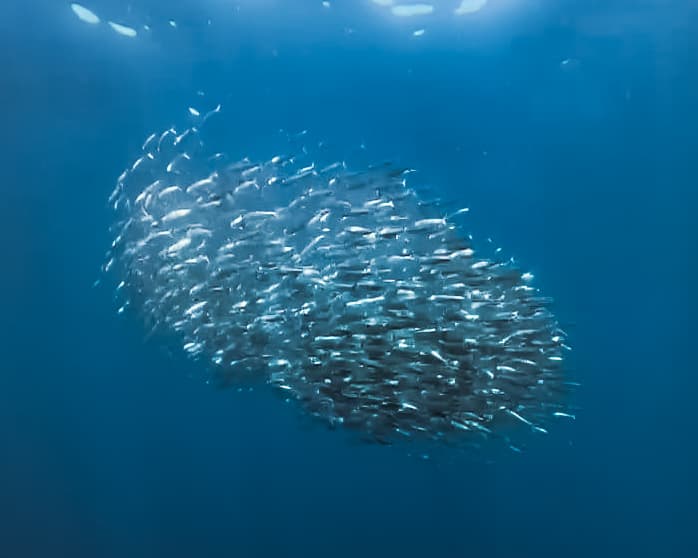
The Pacific sardine (Sardinops sagax) is a small schooling fish that eats plankton: it filters particles smaller than 1.2 mm and also eats zooplankton [1]. In Magdalena Bay it spawns from December to July, peaking in January and February [2]. It feeds marlin, sea lions, birds and whales, and it's very sensitive to temperature: during the 1982–83 El Niño no spawning was recorded in the area [2].
It's a small silver fish that hardly anyone looks at twice. And yet much of the life on Baja California's Pacific coast depends on it. Meet the sardine.
What it eats: a plankton vacuum
The sardine is omnivorous: it eats phytoplankton (microscopic algae) and zooplankton (tiny animals). Particles smaller than 1.2 mm are caught by filtering water through its gills [1]. Although algae are the most numerous items in its stomach, scientists found that zooplankton provides most of its energy [1].
When it spawns
A ten-year study (1982–1992) in Magdalena Bay showed its reproductive cycle runs from December to July, peaking in January and February, with a small bump between July and August [2].
A sardine that follows the tide
Using sonar in the bay, scientists saw sardines gather at the main entrance, the most dynamic area, probably to feed on phytoplankton carried out by the falling tide. They avoid the strongest currents (over 1.2 m per second) and, when the rising tide brings in cold, low-oxygen water, they seem to move up to less than 10 meters deep [3].
A fish that moves with the climate
Sardines, anchovies and mackerel are schooling fish that eat plankton and feed the higher levels of the food chain; because they're so sensitive to climate, they're indicators of the state of the California Current [4]. When its population is very large, the sardine can extend its range 1,000 to 1,800 miles farther along the coast, and 400 to 2,200 miles farther offshore [5].
Birds as sardine "sensors"
In the Gulf of California, the share of sardine in the diet of pelicans, gulls and terns predicts drops in the sardine fishery one or two seasons ahead [7]. When birds stop finding it, it's a warning sign for the whole ecosystem.
Continue with why sardines form bait balls and sardine and anchovy cycles.
Experience it with Keabelmet

Frequently asked questions
What does the Pacific sardine eat?
Phytoplankton and zooplankton; it filters particles smaller than 1.2 mm [1].
When do sardines spawn in Magdalena Bay?
From December to July, peaking in January and February [2].
Scientific sources
The wildlife, season and geography facts in this article come from these publications. The [n] citations in the text link here.
- van der Lingen, C. D. (2002). Diet of sardine Sardinops sagax in the southern Benguela upwelling ecosystem. South African Journal of Marine Science 24(1): 301–316. doi.org/10.2989/025776102784528691
- Torres-Villegas, J. R., Ochoa-Báez, R. I., Perezgómez-Álvarez, L. & García-Melgar, G. (1995). Comparison of seasonal variability in the reproduction of Pacific sardine (Sardinops sagax) from Baja California Sur, Mexico in the years 1982–1992. Scientia Marina 59(3-4): 255–264. www.repositoriodigital.ipn.mx/bitstream/123456789/12965/1/To…
- Robinson, C. J., Gómez-Aguirre, S. & Gómez-Gutiérrez, J. (2007). Pacific sardine behaviour related to tidal current dynamics in Bahía Magdalena, México. Journal of Fish Biology 71(1): 200–218. doi.org/10.1111/j.1095-8649.2007.01484.x
- Valencia-Gasti, J. A., Baumgartner, T. & Durazo, R. (2015). Effects of ocean climate on life cycles and distribution of small pelagic fishes in the California Current System off Baja California. Ciencias Marinas 41(4): 315–348. doi.org/10.7773/cm.v41i4.2571
- Schwartzlose, R. A., Alheit, J., Bakun, A., Baumgartner, T. R., Cloete, R., Crawford, R. J. M., et al. (1999). Worldwide large-scale fluctuations of sardine and anchovy populations. South African Journal of Marine Science 21(1): 289–347. doi.org/10.2989/025776199784125962
- Palomares-García, R., Martínez-López, A., De Silva-Dávila, R., Funes-Rodríguez, R., Carballido-Carranza, M. A., et al. (2003). Biological effects of El Niño 1997-98 on a shallow subtropical ecosystem: Bahía Magdalena, Mexico. Geofísica Internacional 42(3): 455–466. doi.org/10.22201/igeof.00167169p.2003.42.3.915
- Velarde, E., Ezcurra, E. & Anderson, D. W. (2013). Seabird diets provide early warning of sardine fishery declines in the Gulf of California. Scientific Reports 3: 1332. doi.org/10.1038/srep01332
