Sardines vs. anchovies: the Pacific's 50-year cycles (and why science is revisiting them)
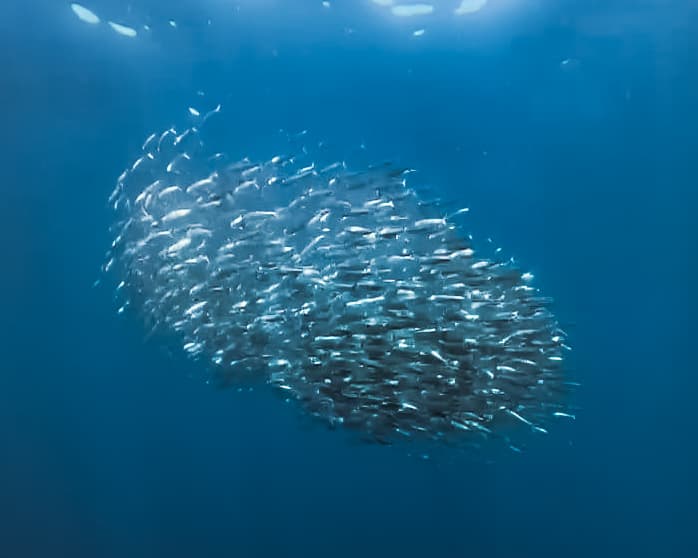
In the Pacific, air and ocean temperatures, productivity and catches of anchovy and sardine have varied in cycles of about 50 years: in the mid-1970s the ocean shifted from a cool "anchovy regime" to a warm "sardine regime", and in the mid to late 1990s it shifted back [1]. Recent studies caution that this alternation is less clear in actual fish biomass than in fishery catches [4].
Imagine the ocean has "seasons" that last decades instead of months. For about 25 years sardines are plentiful; then, for a similar stretch, anchovies dominate. It's one of modern oceanography's most influential ideas.
The finding that changed how we see the sea
In 2003, a study in Science showed that in the Pacific, air and ocean temperatures, atmospheric carbon dioxide, anchovy and sardine catches and ecosystem productivity varied over periods of about 50 years [1]:
- Mid-1970s: the Pacific shifted from a cool "anchovy regime" to a warm "sardine regime" [1].
- Mid to late 1990s: it shifted back to an anchovy regime [1].
The authors warned that these natural variations must be considered when studying human-caused climate change and managing fisheries [1].
A pattern across oceans
Decades-long sardine and anchovy regimes have been seen in the northwest, northeast and southeast Pacific and the southeast Atlantic, and in each system the two species tend to fluctuate out of phase [2]. A species' recovery seems to start with one or a few very successful generations, and overfishing at that early stage can stop it from regaining dominance [2].
What drives them?
One leading hypothesis is that anchovy and sardine populations are limited by the nitrogen reaching their habitat from upwelling, mixing and rivers. Warming, acidification and oxygen loss could affect all of that [3].
Science revisits its own story
A 2020 study analyzed data from five regions and found that the alternation is stronger in fishery catches than in actual fish biomass, and that the two species don't reach equivalent peaks, so one's abundance doesn't make up for the other's scarcity. It also showed that detecting decades-long cycles requires data series more than twice as long as the cycle [4].
That doesn't overturn the 2003 finding, but it shows how science works: a powerful idea gets tested with more data and refined.
A feathered early-warning system
In the Gulf of California, the share of sardine and anchovy in seabird diets predicts drops in the sardine fishery one or two seasons ahead [6]. Sometimes the best way to know what's happening at sea is to look at what birds bring back to their nests.
Experience it with Keabelmet

Frequently asked questions
What is a sardine or anchovy regime?
A decades-long period when one of the two species dominates; in the Pacific, regime shifts happened in the mid-1970s and again in the mid to late 1990s [1].
Do sardines and anchovies always alternate?
Not entirely: a 2020 study found the alternation is stronger in fishery catches than in actual biomass [4].
What limits sardine populations?
A leading hypothesis is nitrogen supplied by upwelling, mixing and rivers [3].
Scientific sources
The wildlife, season and geography facts in this article come from these publications. The [n] citations in the text link here.
- Chavez, F. P., Ryan, J., Lluch-Cota, S. E. & Ñiquen C., M. (2003). From anchovies to sardines and back: multidecadal change in the Pacific Ocean. Science 299(5604): 217–221. doi.org/10.1126/science.1075880
- Schwartzlose, R. A., Alheit, J., Bakun, A., Baumgartner, T. R., Cloete, R., Crawford, R. J. M., et al. (1999). Worldwide large-scale fluctuations of sardine and anchovy populations. South African Journal of Marine Science 21(1): 289–347. doi.org/10.2989/025776199784125962
- Checkley, D. M., Asch, R. G. & Rykaczewski, R. R. (2017). Climate, anchovy, and sardine. Annual Review of Marine Science 9: 469–493. doi.org/10.1146/annurev-marine-122414-033819
- Siple, M. C., Essington, T. E., Barnett, L. A. K. & Scheuerell, M. D. (2020). Limited evidence for sardine and anchovy asynchrony: re-examining an old story. Proceedings of the Royal Society B 287(1922): 20192781. doi.org/10.1098/rspb.2019.2781
- Valencia-Gasti, J. A., Baumgartner, T. & Durazo, R. (2015). Effects of ocean climate on life cycles and distribution of small pelagic fishes in the California Current System off Baja California. Ciencias Marinas 41(4): 315–348. doi.org/10.7773/cm.v41i4.2571
- Velarde, E., Ezcurra, E. & Anderson, D. W. (2013). Seabird diets provide early warning of sardine fishery declines in the Gulf of California. Scientific Reports 3: 1332. doi.org/10.1038/srep01332