Where else is there a Sardine Run? South Africa, Baja California and the world's sardine seas
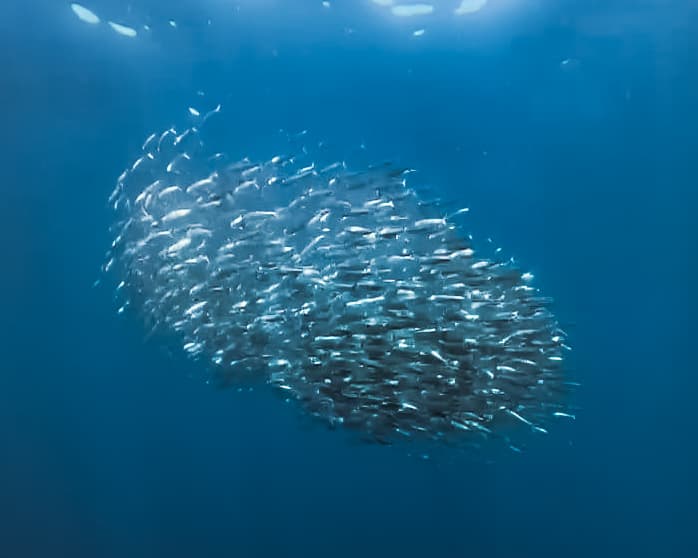
The most famous Sardine Run happens in South Africa: in early austral winter (June–July), a sardine subpopulation migrates along the coast from the Agulhas Bank to KwaZulu-Natal, sometimes beyond Durban, most likely to spawn [1]. On the Pacific coast of Baja California Sur, off Magdalena Bay, marlin hunt schools of sardine and mackerel in autumn, and scientists have filmed them in November [6]. Sardines live along the most productive coasts of the Pacific and the southeast Atlantic [3].
"Sardine Run" has become a popular name among divers and photographers for any place where predators attack big schools. But the original, the one that named the phenomenon, is in South Africa.
South Africa's Sardine Run
In South Africa the term is part of the nation's cultural heritage, yet ecologically it's still poorly understood [1]. According to the most thorough scientific review, it most likely is [1]:
- A seasonal spawning migration in early austral winter.
- By a genetically distinct subpopulation of sardine that travels along the coast from the eastern Agulhas Bank to KwaZulu-Natal, as far as Durban and sometimes beyond.
- Squeezed into a strip near the coast by the sardine's preferred temperature and by the strong, warm Agulhas Current offshore.
- Helped along by a band of cooler coastal water and by ocean eddies and "pulses" that open the way where the shelf is narrowest.
Years when people don't see the Sardine Run may be because it didn't happen due to water that was too warm, or because the migration passed farther offshore and deeper [1].
South Africa vs. Magdalena Bay
| South Africa (KwaZulu-Natal) | Magdalena Bay (BCS) | |
|---|---|---|
| Season | Early austral winter (June–July) [1] | Autumn; marlin filmed in November [6] |
| What it is | Coastal spawning migration of sardines [1] | Predators hunting sardine and mackerel schools in open water [6] |
| Main hunters | Gannets and common dolphins [2] | Striped marlin, sea lions, mahi-mahi and birds |
| Water | Warm Agulhas Current and a cool coastal band [1] | California Current and upwelling |
The sardine seas
The sardine genus Sardinops forms large populations in the productive coastal waters of the northwest, northeast and southeast Pacific and the southeast Atlantic; in Australia it's widespread but with much lower biomass [3]. It's no coincidence: many of those coasts are upwelling systems on the eastern edges of oceans, which are extraordinarily productive for the area they cover [4][5].
Billfish and sardines in other seas
Billfish hunting schools isn't unique to Baja California. In the Atlantic, scientists have documented how sailfish, marlin relatives, slip their bills into sardine schools without triggering an escape and then slash at high speed [8], and how several sailfish alternate their attacks on the same school [7].
Read why the Sardine Run happens at Magdalena Bay and experience it on the Magdalena Bay Ocean Safari.
Experience it with Keabelmet

Frequently asked questions
Where is the most famous Sardine Run?
In South Africa, along the KwaZulu-Natal coast, in early austral winter [1].
Why does South Africa's Sardine Run happen?
It's most likely a spawning migration of a sardine subpopulation that travels along the coast to KwaZulu-Natal [1].
Is there a Sardine Run in Mexico?
Yes, on the Pacific coast of Baja California Sur, off Magdalena Bay, where marlin hunt sardine and mackerel schools in autumn [6].
Scientific sources
The wildlife, season and geography facts in this article come from these publications. The [n] citations in the text link here.
- Fréon, P., Coetzee, J. C., van der Lingen, C. D., Connell, A. D., O’Donoghue, S. H., Roberts, M. J., et al. (2010). A review and tests of hypotheses about causes of the KwaZulu-Natal sardine run. African Journal of Marine Science 32(2): 449–479. doi.org/10.2989/1814232X.2010.519451
- Thiebault, A., Semeria, M., Lett, C. & Tremblay, Y. (2015). How to capture fish in a school? Effect of successive predator attacks on seabird feeding success. Journal of Animal Ecology 85(1): 157–167. doi.org/10.1111/1365-2656.12455
- Schwartzlose, R. A., Alheit, J., Bakun, A., Baumgartner, T. R., Cloete, R., Crawford, R. J. M., et al. (1999). Worldwide large-scale fluctuations of sardine and anchovy populations. South African Journal of Marine Science 21(1): 289–347. doi.org/10.2989/025776199784125962
- Bograd, S. J., Jacox, M. G., Hazen, E. L., Lovecchio, E., Montes, I., Pozo Buil, M., et al. (2023). Climate change impacts on eastern boundary upwelling systems. Annual Review of Marine Science 15: 303–328. doi.org/10.1146/annurev-marine-032122-021945
- Jacox, M. G., Edwards, C. A., Hazen, E. L. & Bograd, S. J. (2018). Coastal upwelling revisited: Ekman, Bakun, and improved upwelling indices for the U.S. West Coast. Journal of Geophysical Research: Oceans 123(10): 7332–7350. doi.org/10.1029/2018JC014187
- Hansen, M. J., Krause, S., Dhellemmes, F., Pacher, K., Kurvers, R. H. J. M., Domenici, P. & Krause, J. (2022). Mechanisms of prey division in striped marlin, a marine group hunting predator. Communications Biology 5: 1161. doi.org/10.1038/s42003-022-03951-3
- Herbert-Read, J. E., Romanczuk, P., Krause, S., Strömbom, D., Couillaud, P., Domenici, P., et al. (2016). Proto-cooperation: group hunting sailfish improve hunting success by alternating attacks on grouping prey. Proceedings of the Royal Society B 283(1842): 20161671. doi.org/10.1098/rspb.2016.1671
- Domenici, P., Wilson, A. D. M., Kurvers, R. H. J. M., Marras, S., Herbert-Read, J. E., Steffensen, J. F., et al. (2014). How sailfish use their bills to capture schooling prey. Proceedings of the Royal Society B 281(1784): 20140444. doi.org/10.1098/rspb.2014.0444