What is upwelling? The invisible engine of Baja California's Pacific
Upwelling is the rise of deep, cold, nutrient-rich water to the surface. It happens when wind blows along the coast and, together with the Earth's rotation, pushes surface water offshore; water from below rises to replace it [1][2]. Those nutrients "fertilize" the sea and make phytoplankton bloom, the base of the food web [2]. Off Magdalena Bay, the rising water comes from 60–70 meters deep [3].
If you jump into the sea off Magdalena Bay in spring and the water feels surprisingly cold, you've just met upwelling. It's one of the most important processes in the ocean, and almost nobody has heard of it.
How it works, in three steps
- Wind blows along the coast. On the eastern edges of oceans, like Baja California's Pacific side, equatorward winds run parallel to the coast [2].
- The Earth spins and the water is deflected. Because of the planet's rotation, the sea's surface layer doesn't move in the wind's direction: it's deflected away from the coast. This is called Ekman transport [2].
- Deep water rises to take its place. It's cold and loaded with nutrients that "fertilize" the surface [1][2].
Why it matters so much
Upwelling systems on the eastern edges of the oceans are extraordinarily productive for the area they cover, and they support huge fisheries [2][6]. The rising water stimulates the growth of microscopic phytoplankton, the base of the marine food web [2]. No upwelling, no Sardine Run.
Upwelling off Magdalena Bay
In spring, satellites detect water off the Magdalena Bay coast up to 4.5 °C colder than its surroundings: water rising from 60–70 meters [3]. A study with 16 monthly cruises 6.5 km from the bay's mouth measured the difference between seasons [4]:
| March–July (upwelling) | August–February (stratified) | |
|---|---|---|
| Surface-layer temperature | 17.7 °C | 23.5 ± 3.2 °C (above the thermocline) |
| Temperature at 80 m | 14.4 °C | 17.0 ± 1.7 °C |
| Surface nitrate | 6.39 μM | 3.90 μM |
| Phytoplankton and production | Higher | Lower |
Table source: Cervantes-Duarte et al. (2018) [4].
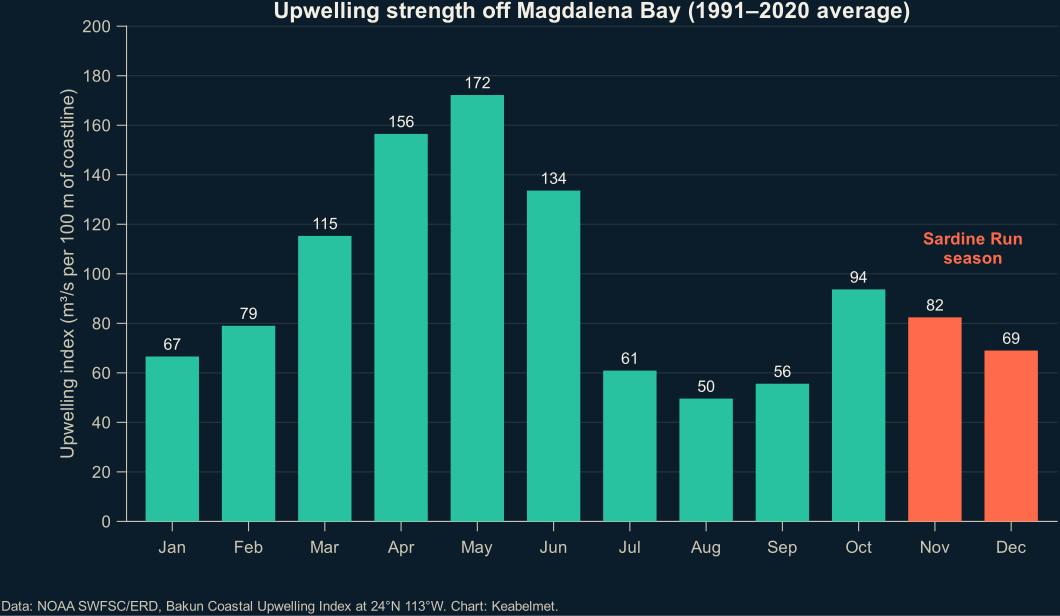
See the chart data
| Month | Index (m³/s per 100 m of coastline) |
|---|---|
| Jan | 67 |
| Feb | 79 |
| Mar | 115 |
| Apr | 156 |
| May | 172 |
| Jun | 134 |
| Jul | 61 |
| Aug | 50 |
| Sep | 56 |
| Oct | 94 |
| Nov | 82 |
| Dec | 69 |
What about climate change?
Scientists have seen a trend toward stronger upwelling in the more poleward parts of these systems, but also more stratified water, and there's still a lot of uncertainty about how their productivity will change [6].
Continue with the Sardine Run food chain or the California Current.
Experience it with Keabelmet

Frequently asked questions
What is upwelling in simple terms?
It's when wind pushes surface water away from the coast and deep, cold, nutrient-rich water rises to replace it [1].
What is Ekman transport?
It's the movement of the sea's surface layer caused by wind and the Earth's rotation; on the eastern coasts of oceans it moves water offshore and drives upwelling [2].
Why is upwelled water so full of life?
Because it brings nutrients that fertilize the surface and make phytoplankton grow, the base of the food web [2].
Scientific sources
The wildlife, season and geography facts in this article come from these publications. The [n] citations in the text link here.
- NOAA National Ocean Service (2024). What is upwelling?. Ocean Facts, National Oceanic and Atmospheric Administration. oceanservice.noaa.gov/facts/upwelling.html
- Jacox, M. G., Edwards, C. A., Hazen, E. L. & Bograd, S. J. (2018). Coastal upwelling revisited: Ekman, Bakun, and improved upwelling indices for the U.S. West Coast. Journal of Geophysical Research: Oceans 123(10): 7332–7350. doi.org/10.1029/2018JC014187
- Zaitsev, O., Trasviña-Castro, A., Linero-Cueto, J., Gaxiola-Castro, G. & Cepeda-Morales, J. (2014). Oceanographic conditions over the continental shelf off Magdalena Bay (Mexico) in 2011–2012. Ciencias Marinas 40(2): 89–112. doi.org/10.7773/cm.v40i2.2314
- Cervantes-Duarte, R., Barón-Campis, S. A., Hernández-Becerril, D. U., Gaxiola-Castro, G. & Lara-Lara, J. R. (2018). Temporal variability of phytoplankton biomass and primary production off Magdalena Bay, Baja California Sur, Mexico. Ciencias Marinas 44(2). doi.org/10.7773/cm.v44i2.2744
- NOAA Southwest Fisheries Science Center, Environmental Research Division (2026). Upwelling Index, 24N 113W, monthly (índice de surgencia costera de Bakun). Conjunto de datos erdUI24mo, NOAA ERDDAP (consultado en octubre de 2026). coastwatch.pfeg.noaa.gov/erddap/info/erdUI24mo/index.html
- Bograd, S. J., Jacox, M. G., Hazen, E. L., Lovecchio, E., Montes, I., Pozo Buil, M., et al. (2023). Climate change impacts on eastern boundary upwelling systems. Annual Review of Marine Science 15: 303–328. doi.org/10.1146/annurev-marine-032122-021945
- González-Rodríguez, E., Trasviña-Castro, A., Gaxiola-Castro, G., Zamudio, L. & Cervantes-Duarte, R. (2012). Net primary productivity, upwelling and coastal currents in the Gulf of Ulloa, Baja California, México. Ocean Science 8(4): 703–711. doi.org/10.5194/os-8-703-2012