The California Current: the cold river that reaches Magdalena Bay
The California Current is a flow of cold water running down the Pacific coast of North America. Magdalena Bay sits at the southern boundary of the transition zone between subarctic and subtropical waters [1]: in winter and spring the water flows south and brings cold influence; in summer and autumn the flow reverses and warmer water arrives from the south [1][2]. That's why temperate and tropical species live here side by side [3].
Picture a giant river inside the ocean, with no banks, slowly flowing down from the north carrying cold water. Now picture that, off Magdalena Bay, this river meets tropical water pushing up from the south. That border is one of the reasons Baja California Sur's Pacific coast is so full of life.
A bay on the border of two worlds
After six oceanographic cruises in 2011 and 2012 off the Magdalena-Almejas lagoon system, scientists concluded the area can be considered the southern boundary of the transition zone between subarctic and subtropical waters of the northeastern Pacific, with very marked seasons [1].
- February and April: in the north of the study area, modified subarctic water intrudes below the surface, and surface water flows south along the coast [1].
- July and October: subtropical water appears below the surface in the south, and the flow turns north [1].
A study using five years of satellite data in the Gulf of Ulloa, just north of Magdalena Bay, found the same pattern: in winter and spring a southward coastal current carries water from upwelling areas to the north and boosts productivity; in summer a warm current with tropical characteristics arrives and suppresses it [2].
Why that makes the bay so rich
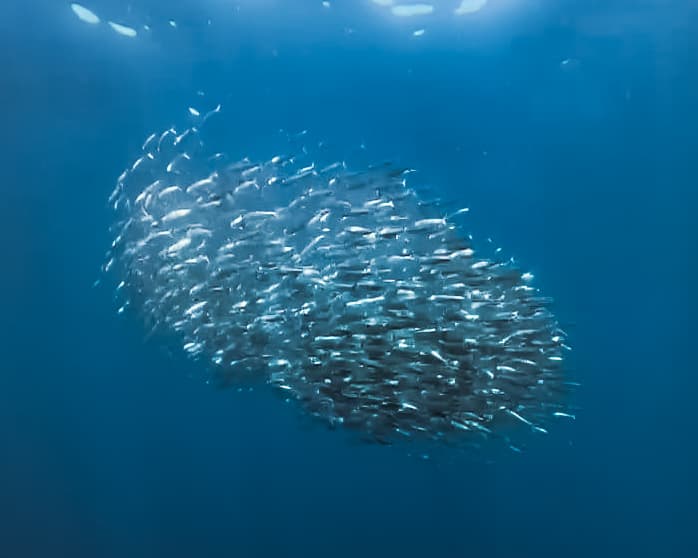
Magdalena Bay's conditions are shaped by the California Current, the Countercurrent and coastal upwelling; because of its location, it's a transition zone between temperate and tropical wildlife [3]. For animals that follow cold water, like the Pacific sardine, it also works as a boundary: between 2000 and 2014, the northern sardine and mackerel stocks contracted south as far as Magdalena Bay in response to regional cooling [5].
What it means for you in the water
Based on our analysis of 30 years of NOAA satellite data off Magdalena Bay, the sea averages about 24 °C in November and 22.5 °C in December, and is coldest in April and May, around 18 °C [6]. See the full chart in Magdalena Bay month by month.
To understand why cold water rises, read what is coastal upwelling?.
Experience it with Keabelmet

Frequently asked questions
What is the California Current?
It's a flow of cold water running down the Pacific coast of North America; off Magdalena Bay it marks the southern boundary of the transition between subarctic and subtropical waters [1].
Why are there both temperate and tropical species in Magdalena Bay?
Because it's a transition zone: it's influenced by the California Current, the Countercurrent and upwelling [3], and the flow changes direction with the seasons [1].
How cold is the water in Magdalena Bay in November?
On average about 24 °C in November and 22.5 °C in December (1991–2020), according to NOAA satellite data [6].
Scientific sources
The wildlife, season and geography facts in this article come from these publications. The [n] citations in the text link here.
- Zaitsev, O., Trasviña-Castro, A., Linero-Cueto, J., Gaxiola-Castro, G. & Cepeda-Morales, J. (2014). Oceanographic conditions over the continental shelf off Magdalena Bay (Mexico) in 2011–2012. Ciencias Marinas 40(2): 89–112. doi.org/10.7773/cm.v40i2.2314
- González-Rodríguez, E., Trasviña-Castro, A., Gaxiola-Castro, G., Zamudio, L. & Cervantes-Duarte, R. (2012). Net primary productivity, upwelling and coastal currents in the Gulf of Ulloa, Baja California, México. Ocean Science 8(4): 703–711. doi.org/10.5194/os-8-703-2012
- Bizzarro, J. J. (2008). A review of the physical and biological characteristics of the Bahía Magdalena lagoon complex (Baja California Sur, Mexico). Bulletin of the Southern California Academy of Sciences 107(1): 1–24. doi.org/10.3160/0038-3872(2008)107[1:AROTPA]2.0.CO;2
- Palomares-García, R., Martínez-López, A., De Silva-Dávila, R., Funes-Rodríguez, R., Carballido-Carranza, M. A., et al. (2003). Biological effects of El Niño 1997-98 on a shallow subtropical ecosystem: Bahía Magdalena, Mexico. Geofísica Internacional 42(3): 455–466. doi.org/10.22201/igeof.00167169p.2003.42.3.915
- Valencia-Gasti, J. A., Baumgartner, T. & Durazo, R. (2015). Effects of ocean climate on life cycles and distribution of small pelagic fishes in the California Current System off Baja California. Ciencias Marinas 41(4): 315–348. doi.org/10.7773/cm.v41i4.2571
- Huang, B., Liu, C., Banzon, V., Freeman, E., Graham, G., Hankins, B., Smith, T. & Zhang, H.-M. (2021). Improvements of the Daily Optimum Interpolation Sea Surface Temperature (DOISST) Version 2.1. Journal of Climate 34(8): 2923–2939 (datos NOAA OISST v2.1 vía ERDDAP, consultados en octubre de 2026). doi.org/10.1175/JCLI-D-20-0166.1