Magdalena Bay month by month: water temperature, plankton and what's happening at sea
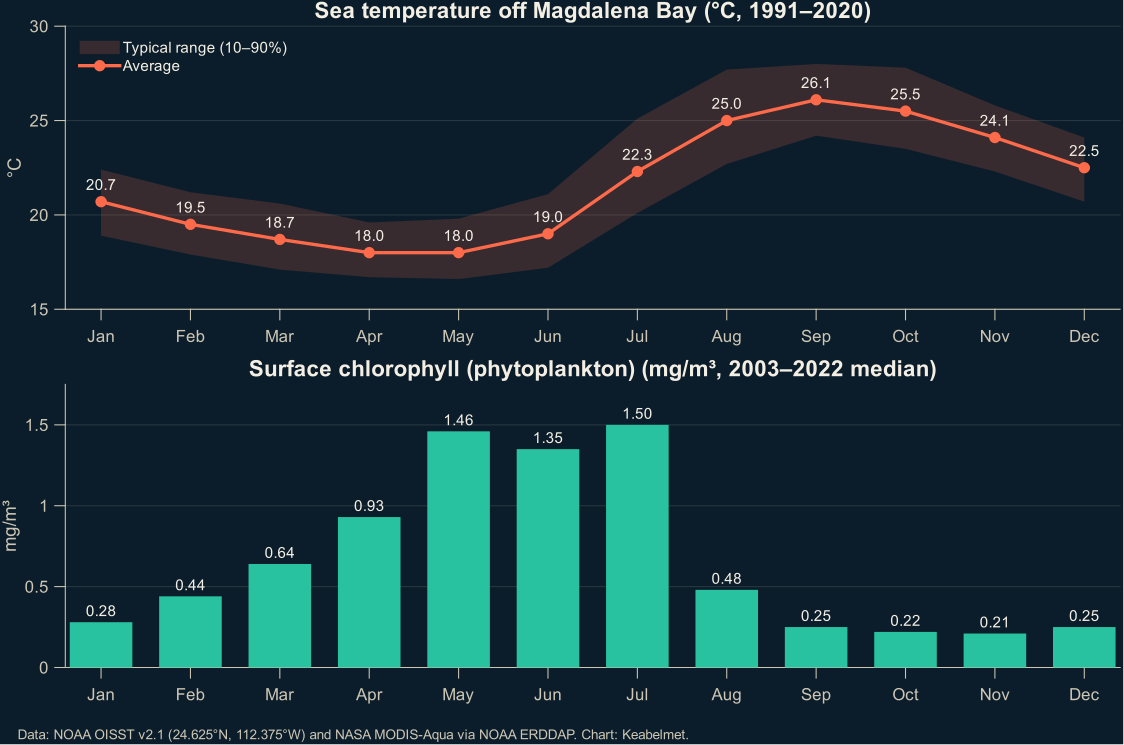
Off Magdalena Bay, the sea averages about 18 °C in April and May (its coldest) and about 26 °C in September (its warmest); during Sardine Run season it's around 24 °C in November and 22.5 °C in December (1991–2020) [1]. Phytoplankton peaks from May to July [2], after the year's strongest upwelling in spring [3].
Magdalena Bay changes a lot through the year. To describe it with data rather than impressions, we analyzed 30 years of sea temperature, 20 years of chlorophyll seen from space and NOAA's upwelling index.
See the chart data
| Month | Avg. temp. (°C) | Typical range (°C) | Chlorophyll (mg/m³) | Upwelling index |
|---|---|---|---|---|
| Jan | 20.7 | 18.9–22.4 | 0.28 | 67 |
| Feb | 19.5 | 17.9–21.2 | 0.44 | 79 |
| Mar | 18.7 | 17.1–20.6 | 0.64 | 115 |
| Apr | 18.0 | 16.7–19.6 | 0.93 | 156 |
| May | 18.0 | 16.6–19.8 | 1.46 | 172 |
| Jun | 19.0 | 17.2–21.1 | 1.35 | 134 |
| Jul | 22.3 | 20.1–25.1 | 1.50 | 61 |
| Aug | 25.0 | 22.7–27.7 | 0.48 | 50 |
| Sep | 26.1 | 24.2–28.0 | 0.25 | 56 |
| Oct | 25.5 | 23.5–27.8 | 0.22 | 94 |
| Nov | 24.1 | 22.3–25.8 | 0.21 | 82 |
| Dec | 22.5 | 20.7–24.1 | 0.25 | 69 |
The "typical range" is the interval covering 80% of days (10th to 90th percentile) from 1991 to 2020 [1]. The upwelling index is in m³/s per 100 m of coastline [3].
Spring (March–June): the cold, green sea
It's upwelling season: the index peaks in May [3] and the water is the coldest of the year, around 18 °C in April and May [1]. From March to July the water is well mixed and full of nutrients, with more phytoplankton and higher production [4]. Krill reproduce most intensely in spring and early summer [6].
Summer (July–September): the sea warms up
Chlorophyll is still high in July but crashes in August [2], when the water stratifies and a warm current with tropical characteristics arrives and cuts productivity [4][7]. In September the sea peaks at about 26 °C [1].
Autumn and early winter (October–December): Sardine Run season
Upwelling picks up again in October [3] and the water starts cooling: about 24 °C in November and 22.5 °C in December [1]. That's when we run the Magdalena Bay Ocean Safari. The Pacific sardine starts its spawning cycle in December [5].
Winter (January–February): gray whales and spawning sardines
Sardines hit their spawning peak in January and February [5], and the water drops to about 19.5–20.7 °C [1]. It's gray whale season in Puerto Chale.
Heading to La Paz rather than the Pacific coast? Read La Paz water temperature by month.
Experience it with Keabelmet


Frequently asked questions
How cold is the water in Magdalena Bay in December?
About 22.5 °C on average, usually between 20.7 and 24.1 °C (1991–2020) [1].
What is the coldest month in Magdalena Bay?
April and May, at about 18 °C on average, in the middle of upwelling season [1][3].
When is there the most plankton in Magdalena Bay?
From May to July, according to 20 years of satellite chlorophyll data [2].
Scientific sources
The wildlife, season and geography facts in this article come from these publications. The [n] citations in the text link here.
- Huang, B., Liu, C., Banzon, V., Freeman, E., Graham, G., Hankins, B., Smith, T. & Zhang, H.-M. (2021). Improvements of the Daily Optimum Interpolation Sea Surface Temperature (DOISST) Version 2.1. Journal of Climate 34(8): 2923–2939 (datos NOAA OISST v2.1 vía ERDDAP, consultados en octubre de 2026). doi.org/10.1175/JCLI-D-20-0166.1
- NASA Ocean Biology Processing Group; NOAA SWFSC Environmental Research Division (2022). Chlorophyll-a, Aqua MODIS, NPP, L3SMI, global, 4 km, science quality, monthly composite. Conjunto de datos erdMH1chlamday, NOAA ERDDAP. coastwatch.pfeg.noaa.gov/erddap/info/erdMH1chlamday/index.ht…
- NOAA Southwest Fisheries Science Center, Environmental Research Division (2026). Upwelling Index, 24N 113W, monthly (índice de surgencia costera de Bakun). Conjunto de datos erdUI24mo, NOAA ERDDAP (consultado en octubre de 2026). coastwatch.pfeg.noaa.gov/erddap/info/erdUI24mo/index.html
- Cervantes-Duarte, R., Barón-Campis, S. A., Hernández-Becerril, D. U., Gaxiola-Castro, G. & Lara-Lara, J. R. (2018). Temporal variability of phytoplankton biomass and primary production off Magdalena Bay, Baja California Sur, Mexico. Ciencias Marinas 44(2). doi.org/10.7773/cm.v44i2.2744
- Torres-Villegas, J. R., Ochoa-Báez, R. I., Perezgómez-Álvarez, L. & García-Melgar, G. (1995). Comparison of seasonal variability in the reproduction of Pacific sardine (Sardinops sagax) from Baja California Sur, Mexico in the years 1982–1992. Scientia Marina 59(3-4): 255–264. www.repositoriodigital.ipn.mx/bitstream/123456789/12965/1/To…
- Gómez-Gutiérrez, J., De Silva-Dávila, R. & Lavaniegos-Espejo, B. (1996). Growth production of the euphausiid Nyctiphanes simplex on the coastal shelf off Bahía Magdalena, Baja California Sur, México. Marine Ecology Progress Series 138: 309–314. doi.org/10.3354/meps138309
- González-Rodríguez, E., Trasviña-Castro, A., Gaxiola-Castro, G., Zamudio, L. & Cervantes-Duarte, R. (2012). Net primary productivity, upwelling and coastal currents in the Gulf of Ulloa, Baja California, México. Ocean Science 8(4): 703–711. doi.org/10.5194/os-8-703-2012