La Paz water temperature by month (and which wetsuit to wear)

In the bay of La Paz the water is coldest in February (about 20.5 °C / 69 °F on average) and warmest in September (about 29 °C / 84 °F), based on 1991–2020 averages calculated from NOAA satellite data [1]. From December to May a full wetsuit is a good idea; from July to October a shorty or rash guard is enough.
Is the water cold? It's question number one before any trip out to sea. To answer it properly, we didn't want to guess: we took 30 years of satellite sea temperature data and calculated the average for each month in the center of the bay of La Paz.
The table: water temperature month by month
| Month | Average | Typical range* | Recommended wetsuit |
|---|---|---|---|
| January | 21.0 °C / 70 °F | 19.8 – 22.3 °C | Full 5 mm |
| February | 20.5 °C / 69 °F | 19.4 – 21.8 °C | Full 5 mm (coldest month) |
| March | 20.8 °C / 69 °F | 19.7 – 21.9 °C | Full 5 mm |
| April | 21.7 °C / 71 °F | 20.4 – 22.9 °C | Full 3–5 mm |
| May | 23.1 °C / 74 °F | 21.8 – 24.4 °C | Full 3 mm |
| June | 24.2 °C / 76 °F | 22.3 – 26.5 °C | Full 3 mm or shorty |
| July | 26.7 °C / 80 °F | 24.2 – 28.6 °C | Shorty or rash guard |
| August | 28.7 °C / 84 °F | 27.3 – 30.1 °C | Rash guard |
| September | 29.1 °C / 84 °F | 27.8 – 30.2 °C | Rash guard (warmest month) |
| October | 28.6 °C / 83 °F | 27.3 – 29.8 °C | Rash guard or shorty |
| November | 26.4 °C / 80 °F | 25.1 – 27.8 °C | Shorty or full 3 mm |
| December | 23.4 °C / 74 °F | 22.0 – 24.9 °C | Full 3–5 mm |
*The typical range goes from the 10th to the 90th percentile: 80% of days fall within it. NOAA OISST v2.1 data, 1991–2020 [1]. The wetsuit recommendation is ours, from years of getting in the water; if you get cold easily, go one level up.
Why does it change so much?
The bay of La Paz has a strong annual cycle of warming and cooling, linked to the inflow of nutrient-rich coastal water and water exchange with the Gulf of California [2]. Winds drive that cycle [2].
Temperature also decides who shows up: a 15-year study found that warmer water favors whale sharks in the bay of La Paz [3].
What does it mean for your trip?
- Winter (December–March): water around 20–23 °C (68–73 °F). Not freezing, but after a while in the water you feel it; a full wetsuit makes the difference.
- Spring (April–June): the water warms up; perfect for mobula rays and snorkeling in a 3 mm suit.
- Summer and fall (July–October): warm water, ideal for long snorkels and comfortable diving.
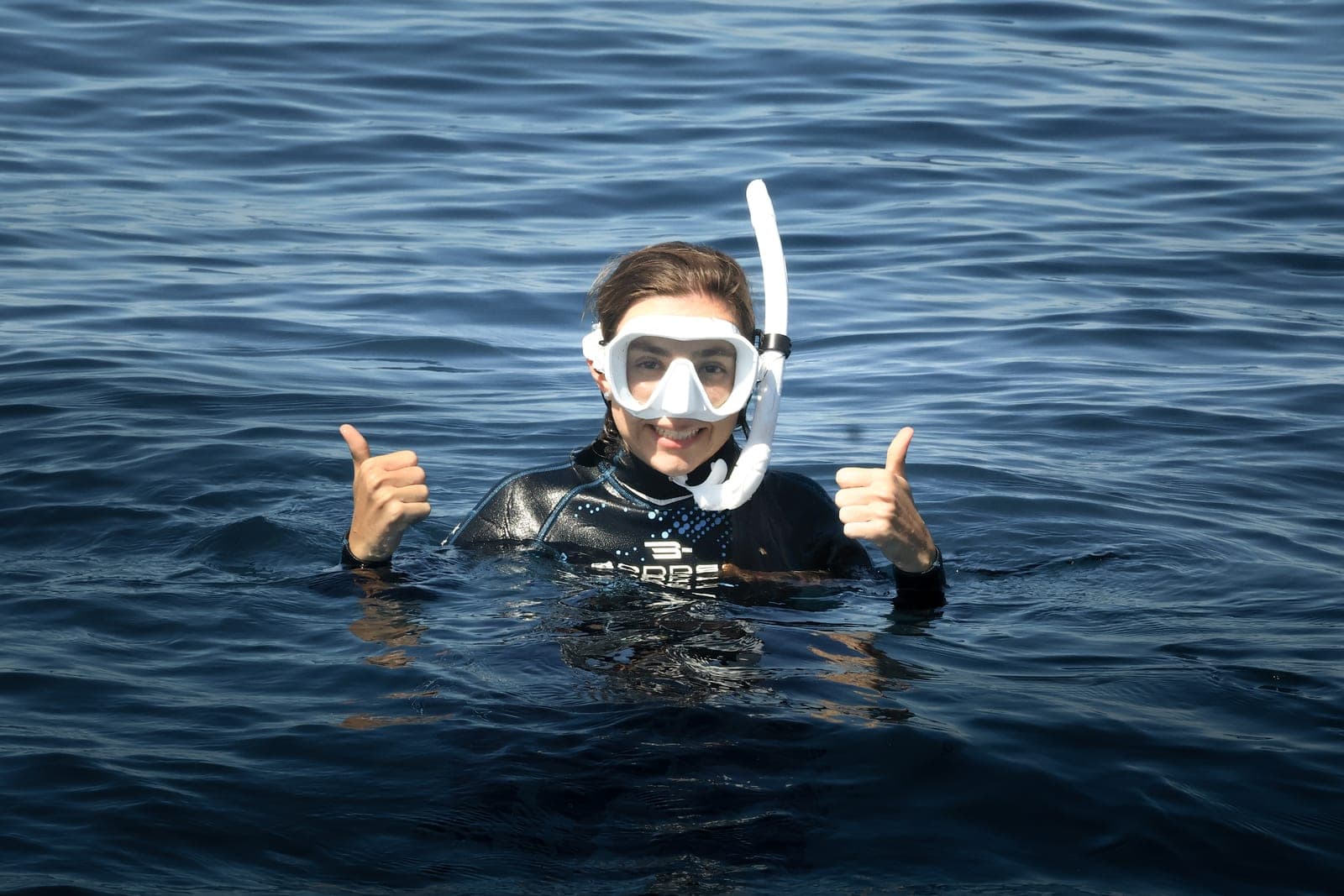
Our snorkel and dive tours include the gear and the right wetsuit for the season. Check the best time to visit La Paz to match water temperature with each month's wildlife.
Experience it with Keabelmet


Frequently asked questions
How cold is the water in La Paz in winter?
From December to March averages range from about 20.5 to 23.4 °C (69–74 °F); February is the coldest month [1].
When is the water warmest in La Paz?
In September, about 29 °C (84 °F) on average; August and October are also above 28 °C [1].
Do I need a wetsuit in La Paz?
From December to May, yes: we recommend a full wetsuit. From July to October a rash guard or shorty is enough.
Scientific sources
The wildlife, season and geography facts in this article come from these publications. The [n] citations in the text link here.
- Huang, B., Liu, C., Banzon, V., Freeman, E., Graham, G., Hankins, B., Smith, T. & Zhang, H.-M. (2021). Improvements of the Daily Optimum Interpolation Sea Surface Temperature (DOISST) Version 2.1. Journal of Climate 34(8): 2923–2939. Promedios y percentiles mensuales 1991–2020 calculados por Keabelmet para 24.375° N, 110.625° O (Bahía de La Paz) con los datos NOAA OISST v2.1 vía ERDDAP. doi.org/10.1175/JCLI-D-20-0166.1
- Herrera-Cervantes, H. (2019). Sea surface temperature, ocean color and wind forcing patterns in the Bay of La Paz, Gulf of California: Seasonal variability. Atmósfera 32(1): 25–38. doi.org/10.20937/atm.2019.32.01.03
- Ornelas, T., García-Baciero, A., Moreno-Mendoza, J., Crespo-Neto, O., Tollrian, R. & Ramírez-Macías, D. (2026). Influence of oceanographic and atmospheric parameters on whale shark Rhincodon typus abundance in Bahía de La Paz, Mexico. Marine Ecology Progress Series 788: 1–15. doi.org/10.3354/meps15136
- Bizzarro, J. J. (2008). A review of the physical and biological characteristics of the Bahía Magdalena lagoon complex (Baja California Sur, Mexico). Bulletin of the Southern California Academy of Sciences 107(1): 1–24. doi.org/10.3160/0038-3872(2008)107[1:AROTPA]2.0.CO;2