When and where to see gray whales in Baja California Sur: season guide
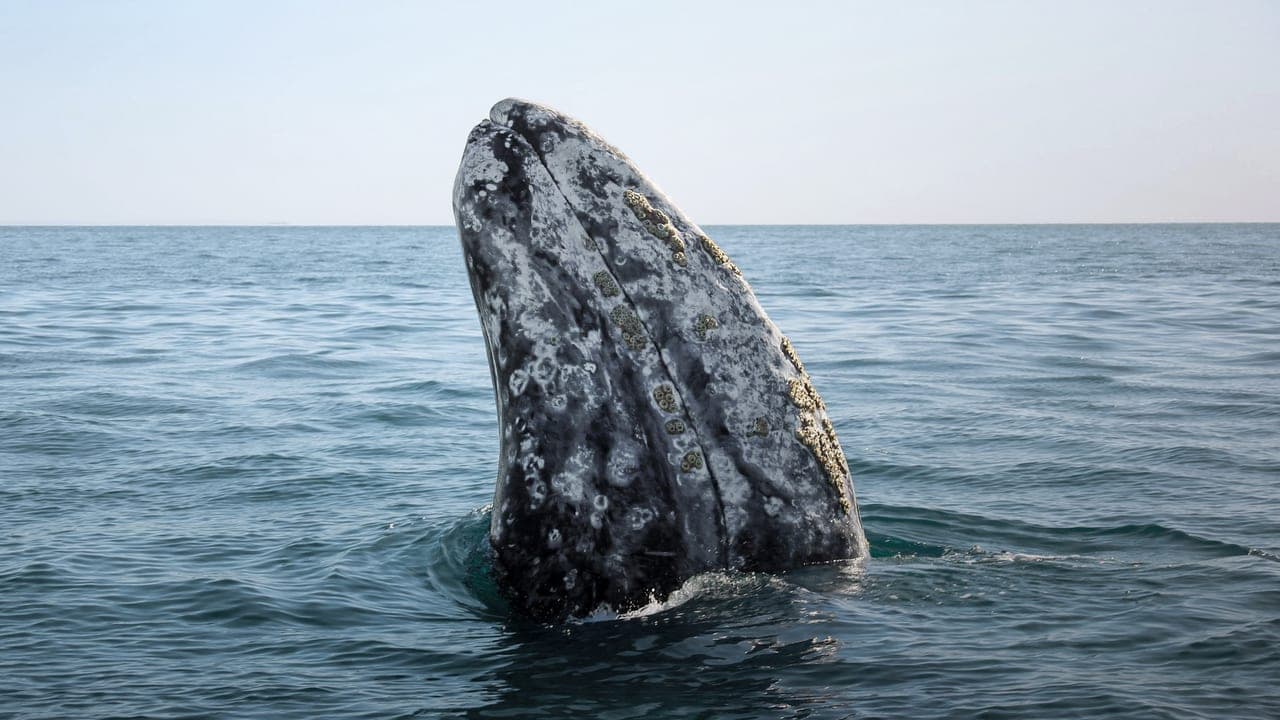
The best time to see gray whales in Baja California Sur is January to March, when they winter in the lagoons and bays of the Pacific coast. Calves are born between early January and mid-February [1]. From La Paz, the closest option is the Magdalena Bay lagoon complex, home to Puerto Chale.
Every winter, the Pacific coast of Baja California Sur welcomes visitors that travel all the way from the Arctic. If you've ever dreamed of seeing a whale a few meters from your boat, this is the time and place.
The season: January to March
Eastern North Pacific gray whales spend the summer feeding in the Bering and Chukchi Seas and head down to the lagoons of Baja California in winter to breed and give birth [5]. According to NOAA, calves are born during the migration or in the shallow lagoons and bays of Mexico from early January to mid-February [1].
That's why Keabelmet's Puerto Chale tour runs January to March: it's when the lagoons are most active, with mothers, calves and adults.
Where to see them: the Magdalena Bay complex
Magdalena Bay is an extremely productive lagoon system on the Pacific coast of Baja California Sur, shaped by the California Current and by upwelling of cold, nutrient-rich water [4]. One study divided the complex into three zones, and each plays a different role for the whales [2]:
| Zone | What whales use it for |
|---|---|
| Santo Domingo Channel (north, Puerto Adolfo López Mateos) | Main calving area: the most mother-calf pairs [2] |
| Magdalena Bay (central) | Courtship and mating; young whales [2] |
| Almejas Bay (south) | Courtship and mating; groups of young and immature whales [2] |
Further north are other famous breeding lagoons such as Ojo de Liebre [5], but from La Paz the Magdalena Bay complex is the most accessible: you cross the desert to the Pacific in a few hours. Our tour leaves La Paz around 5:00 a.m. and you're back in the afternoon.
Why do they come close to the boats?
Gray whales are famous because, in some lagoons, they approach boats voluntarily. It doesn't always happen or with every whale, and it should never be forced. What we do know is that coastal lagoons are key to their reproductive success [3], which is why responsible whale watching (engine in neutral, no chasing) matters so much.
A species that came back
The Eastern North Pacific gray whale population was nearly wiped out by commercial whaling, recovered, and was removed from the US endangered species list in 1994 [1]. Today it may be close to its carrying capacity [3]. Seeing them means witnessing one of the ocean's great recovery stories. And if you're wondering how they get here, read why gray whales travel to Baja California.
Experience it with Keabelmet

Frequently asked questions
What's the best month to see gray whales?
January, February and March. Calves are born between early January and mid-February [1], so in February and March it's common to see mothers with their calves.
Can you see gray whales from La Paz?
Not in the bay of La Paz: they live in the Pacific lagoons. From La Paz you reach the Magdalena Bay complex, where Puerto Chale is, in a few hours.
Can you touch gray whales?
The goal is never to touch them. If one approaches on its own, follow the captain's instructions and current regulations.
How much does a gray whale weigh?
Adults can grow to about 15 meters (49 feet) and weigh around 40 tonnes (90,000 pounds) [1].
Scientific sources
The wildlife, season and geography facts in this article come from these publications. The [n] citations in the text link here.
- NOAA Fisheries (2024). Gray Whale (Eschrichtius robustus). National Oceanic and Atmospheric Administration, ficha de especie. www.fisheries.noaa.gov/species/gray-whale
- Pérez-Cortés M., H., Urbán R., J. & Loreto C., P. A. (2004). A note on gray whale distribution and abundance in the Magdalena Bay Complex, México during the 1997 winter season. Journal of Cetacean Research and Management 6(2): 133–138. doi.org/10.47536/jcrm.v6i2.776
- Urbán R., J., Rojas-Bracho, L., Pérez-Cortés, H., Gómez-Gallardo, A., Swartz, S. L., Ludwig, S. & Brownell Jr., R. L. (2003). A review of gray whales (Eschrichtius robustus) on their wintering grounds in Mexican waters. Journal of Cetacean Research and Management 5(3): 281–295. doi.org/10.47536/jcrm.v5i3.808
- Bizzarro, J. J. (2008). A review of the physical and biological characteristics of the Bahía Magdalena lagoon complex (Baja California Sur, Mexico). Bulletin of the Southern California Academy of Sciences 107(1): 1–24. doi.org/10.3160/0038-3872(2008)107[1:AROTPA]2.0.CO;2
- Urbán R., J., Jiménez-López, E., Guzmán, H. M. & Viloria-Gómora, L. (2021). Migratory behavior of an Eastern North Pacific gray whale from Baja California Sur to Chirikov Basin, Alaska. Frontiers in Marine Science 8: 619290. doi.org/10.3389/fmars.2021.619290